Experts of the Atlantic Council and Experts Club discussed Donald Trump’s future policy
Donald Trump will officially begin his term as the 47th president of the USA today. His possible actions and strategies on the international stage became the main topic of discussion at a meeting of experts organized by the Atlantic Council and Experts Club. Brian Mefford, senior fellow at the Eurasia Center of the Atlantic Council, and the founder of Experts Club, Maksym Urakin, examined the key issues that will influence
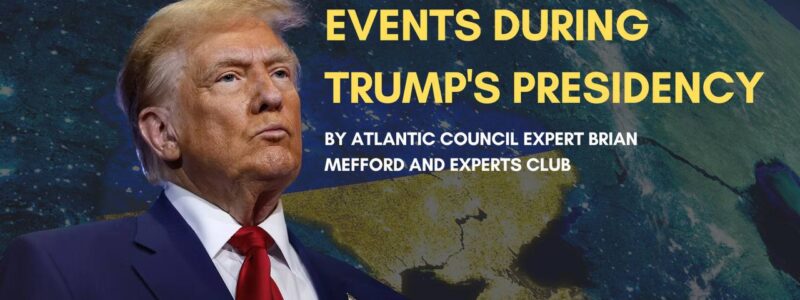
Donald Trump officially begins his term today as the 47th President of the USA. His possible actions and strategies on the international stage became the main topic of discussion at a meeting of experts organized by the Atlantic Council and Experts Club. Brian Mefford, senior fellow at the Atlantic Council’s Eurasia Center, and Maksym Urakin, founder of Experts Club, examined the key issues that will affect the geopolitical situation in the world, in particular Ukraine.
Brian Mefford noted that Trump’s first months in office will be focused on resolving domestic issues, such as confirming the members of his cabinet in the Senate. However, the expert stressed that Ukraine will remain an important U.S. foreign policy issue.
“Ukraine already has a special envoy – Gen. Kellogg. Although his visit to Kyiv was postponed, this shows that Ukraine remains among the priorities. Its security is crucial for stability in the region,” Mefford noted.
One of the key topics of discussion was Ukraine’s NATO membership, which was first promised back at the Bucharest summit in 2008. In Brian Mefford’s view, this decision could have prevented many of today’s problems.
“That was a serious mistake at the time. Russia exploited this uncertainty: first in Georgia, and then in Ukraine. Now, because of the war on its own territory, the NATO question for Ukraine is postponed indefinitely. At the same time, long-term security guarantees are needed. Ukraine needs modern weapons, so the U.S. and European partners must remain reliable allies of Ukraine,” he explained.
At the same time, according to the expert, the issue of NATO funding was one of the most discussed during Trump’s first presidency, when he urged European countries to increase their defense spending.
“The U.S. spends more on defense than the next nine countries combined. Trump was right to insist that European countries spend at least 2% of GDP on defense. And now these requirements are being met. Growth in defense spending in Europe is in everyone’s interest. The Alliance remains a powerful instrument for ensuring stability,” Mefford stressed.
According to him, a U.S. withdrawal from NATO is currently an unlikely scenario.
Mefford suggested that the Trump administration will continue a tough economic policy toward China, including trade wars.
“China does not follow fair rules in international trade. Support for Taiwan will remain unchanged, since the U.S. has strategic interests in the region. China often demonstrates strength, yet its economy is on the verge of recession, and its military power is exaggerated,” he explained.
The expert also touched on the issue of sanctions against Russia, which remain an effective instrument of international pressure.
“During his previous term Trump imposed more sanctions on Russia than Obama. Their easing is possible only if the war ends. This is a long-term mechanism that cannot be ignored,” Mefford emphasized.
The founder of the Experts Club think tank, Maksym Urakin, for his part, stressed the importance of Donald Trump’s election for Ukraine and the world and recalled other important elections for Ukraine and the region in 2025:
“Partnership with the U.S. is crucial for Ukraine. However, we should be ready for different scenarios, strengthen our own economic resilience and diversify our foreign policy, given the very important elections this year in Germany, Poland, Romania, Moldova and Canada. The world is becoming ever more dynamic,” noted Maksym Urakin.
The experts’ analysis showed that Trump’s policy toward Ukraine will be shaped by both domestic and external factors. At the same time, Ukraine’s role in global security will only grow, and international support will remain critically important for security on the European continent.
You can watch the full version of the video at the link: