From wound to victory: is Ukraine ready for systematic rehabilitation of veterans through sport
On April 16, 2026, the National University of Ukraine on Physical Education and Sport hosted an open expert meeting “From Wound to Victory: Is Ukraine Ready for a New Rehabilitation System?”, which became not just a discussion platform but an attempt to shape a shared vision of the future model of adaptive sport and rehabilitation in Ukraine. The event brought together representatives of state institutions, the relevant ministries, the academic and educational community,
On April 16, 2026, the National University of Ukraine on Physical Education and Sport hosted an open expert meeting
“From Wound to Victory: Is Ukraine Ready for a New Rehabilitation System?”, which became not just a discussion platform but an attempt to shape a shared vision of the future model of adaptive sport and rehabilitation in Ukraine.
The event brought together representatives of state institutions, the relevant ministries, the academic and educational community, the national Olympic university, civil-society organisations, the sports community, rehabilitation centres and the veterans themselves — those for whom this system should work first and foremost.
The full-scale war has radically changed the social structure of Ukrainian society. Thousands of service members are returning to civilian life with injuries — both physical and psychological. In this context, rehabilitation ceases to be a narrow medical topic and becomes a matter of national resilience.
Adaptive sport plays a far broader role in this process than mere physical activity. It is a tool of: physical recovery, psycho-emotional stabilisation, social integration, the formation of a new identity after trauma
However, the main challenge voiced repeatedly during the meeting is the lack of a systematic approach.
Opening the event, the director of the NUFVSU training and rehabilitation centre, Viktor Korzh, immediately outlined the key problem: Ukraine already has many initiatives, but they remain fragmented.
“Physical and sports rehabilitation and adaptive sport are an extremely important social component that should serve the recovery and social integration of our veterans who have been wounded.
This requires an individual approach, professional medical support and consideration of each person's state of health.
Only then will these tools truly bring benefit and do no harm.
Sport and physical rehabilitation are powerful tools that must be based on deep knowledge and responsibility, and only then will they truly bring benefit and do no harm.”
His thesis set the tone for the whole discussion: it is not about creating new separate projects but about building a coherent ecosystem.
Particular attention was paid to the role of education in shaping this system.
The acting rector of the National University of Ukraine on Physical Education and Sport, Olha Borysova, stressed the strategic importance of training specialists.
“Today universities must go beyond classical education and become centres for shaping a new rehabilitation system.
We are talking about training specialists who will work at the intersection of sport, medicine and psychology.
It is precisely such personnel that will ensure the quality and safety of veterans' recovery process.”
This approach underlines that the problem of adaptive sport is not only organisational but also one of personnel. Without systematic training of specialists, even the best programmes cannot work effectively.
An important part of the discussion was an analysis of the experience of the USA and Israel — countries with many years of practice in working with veterans.
Artem Honcharenko, head of the Institute of Rehabilitation, Reintegration and Professional Development “Architecture of Resilience” at KNUBA, stressed that the key feature distinguishing these systems is their integration.
“In the USA and Israel, adaptive sport does not exist separately — it is integrated into state rehabilitation policy.
It is part of a continuous process: from the hospital to full return to society.
It is important for Ukraine not simply to adopt this experience but to embed it correctly into its own system.”
In effect, this is about moving from “help after trauma” to a model of “accompanying a person at all stages of recovery”.
One of the strongest moments of the meeting was the speech of veteran Vadym Honcharenko, who shared his own experience of taking part in international competitions.
“Adaptive sport is not only about physical recovery.
It is about regaining faith in oneself, about the chance to feel in control of one's own life again.
It was through sport that I was able to find new motivation and return to active life.”
His words in effect confirmed what the experts had been saying: the effectiveness of the system is measured not by the number of programmes but by changes in the lives of specific people.
Also among the participants in the meeting were: the head of the Sports Committee of Ukraine, Illia Shevliak, the head of the department for physical and mental health of the Ministry of Veterans Affairs of Ukraine, Viacheslav Chernenko, and other guests who took an active part in the discussion.
One of the main conclusions of the meeting was the need for genuine cooperation between the state, educational institutions, business and civil-society organisations. Without such interaction, the system of adaptive sport will remain fragmented and will not be able to ensure a lasting effect.
The meeting at the National University of Ukraine on Physical Education and Sport showed that Ukraine already has an understanding of the problem and all the key players to solve it. However, the next step is to consolidate efforts for the full return of veterans to a full life.
Adaptive sport today is not only about physical activity. It is about a new social policy, about bringing people back to life, about the state's ability to respond to the challenges of war.
And the main question that remained after the event:
will Ukraine be able to unite all these efforts into a single system that works not selectively but for every veteran?
The answer to it depends not on words but on the decisions that will be taken in the near future.
We also draw your attention to the fact that the admission campaign is beginning
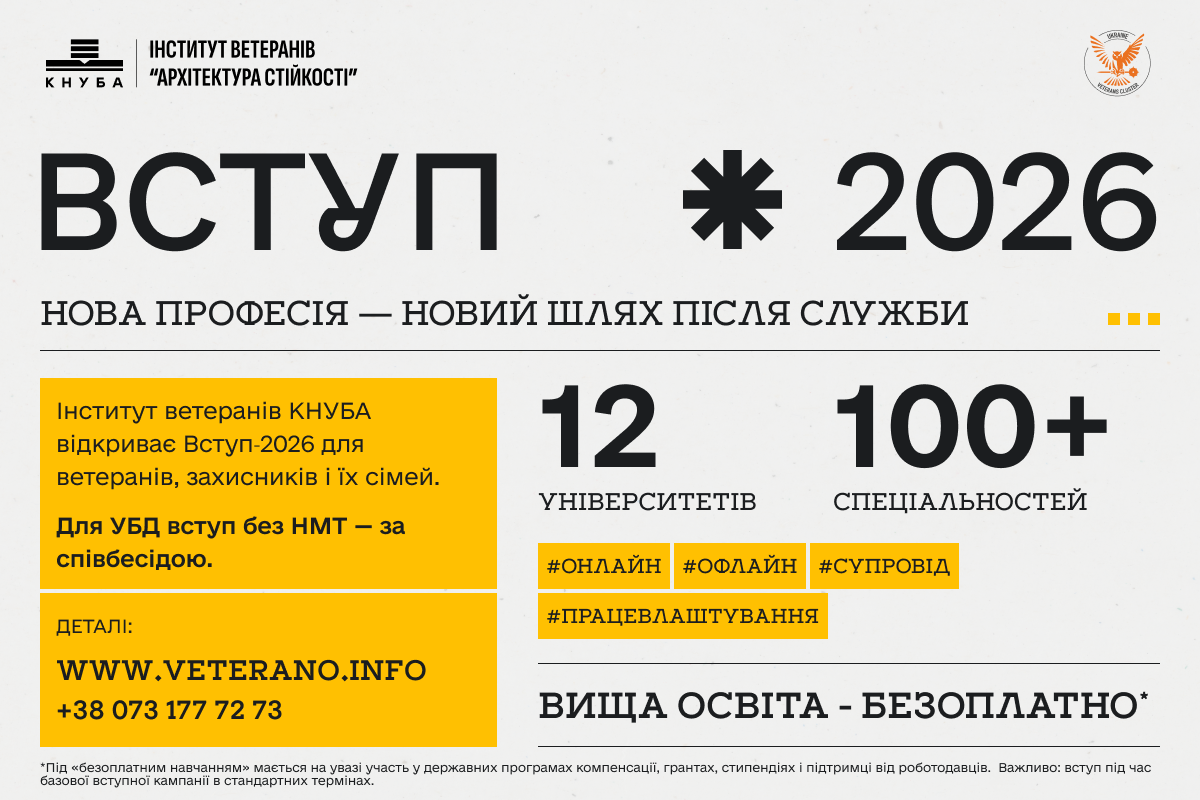
Admission 2026: A new profession — a new path after service
The KNUBA Veterans Institute opens Admission 2026 for veterans, defenders and their families. For UBD holders, admission is without the NMT — by interview.
12 universities. More than 100 specialties, online and offline formats, support all the way to employment.
This is a step from service — to a new profession. Details: www.veterano.info (http://www.veterano.info/)
 073 177 72 73