Barrier-free accessibility in Ukraine: from personal pain to systemic solutions
Barrier-free accessibility is often perceived as something abstract: a term from presentations, an item in strategies, a section in reports. But for thousands of Ukrainians, it begins very simply — with the inability to travel a few meters. A curb, stairs, doors, tiles. What most people do not notice becomes a boundary for others. It is precisely from this — from the everyday, almost unnoticeable restrictions — that the real conversation begins
Accessibility is often perceived as something abstract: a term from presentations, a line in strategies, a section in reports.
But for thousands of Ukrainians it begins very simply — with being unable to get past a few metres.
Curb, stairs, doors, tiles.
What most people do not notice becomes a limit for others.
It is precisely from this — from everyday, almost unnoticeable restrictions — that the real conversation about accessibility begins.
A personal story that started it all.
For Artem Honcharenko, this topic is not just a professional interest. It is far closer and more painful, because it is about his father.
Vadym Honcharenko, a war veteran, call sign “Kinolog”.
After being wounded, he could not get back on his feet. Now Vadym gets around in a wheelchair and has a group I disability. After the front, he returned to civilian life, but it turned out that the space that used to be familiar and comfortable was no longer so.
The first months after the injury showed: the state, the city, the services exist as if in a parallel dimension. A dimension where people close their eyes so as not to see the problems that people with disabilities face every day.
When every little detail seems to read: “We didn't expect you to be here”
At first glance, the barriers do not look catastrophic, but for someone they can become a serious problem. For example
- stairs without an alternative;
- a ramp with a dangerous slope;
- a curb a few centimeters high;
- tactile paving that blocks wheels;
- narrow doors and the absence of an elevator
Each of these elements on its own seems minor, but
they create a feeling: “your needs and your comfort have not been taken into account here”.
It was precisely this experience that made Artem and his team look not for sympathy but for solutions.
The “trial and error” method
A year after his injury, Vadym “Kinolog” began working with other veterans who return from the front with a disability. He trains, supports, and shares his experience.
But this experience is gained through trial and error — literally on one's own body.
Each incorrectly designed element means:
- falls;
- additional trauma;
- pain;
- risk of complications.
And it is precisely here that it becomes obvious that accessibility cannot be built through people's suffering.
All-Ukrainian Barrier-Free Week: what we did in practice
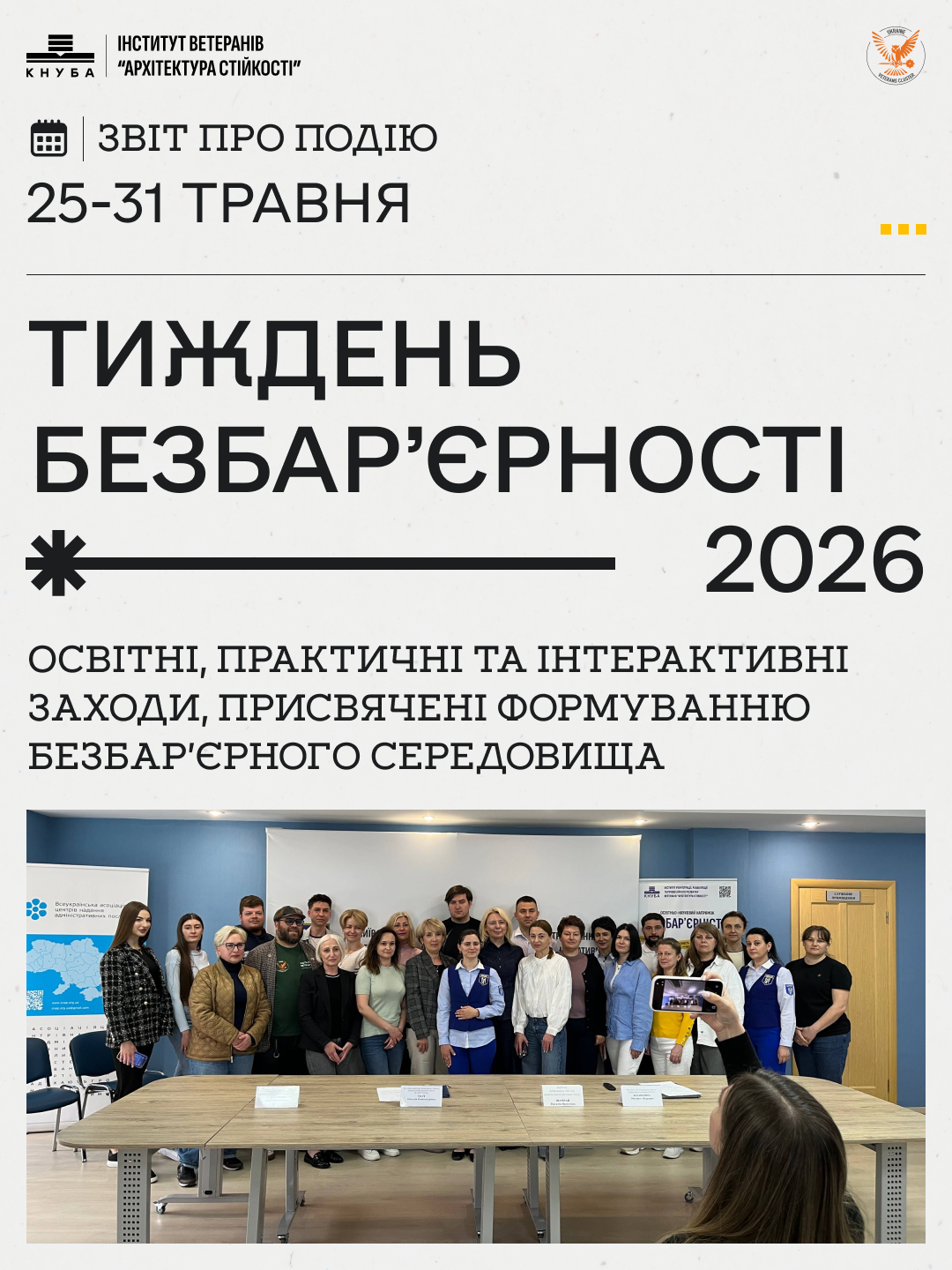
From this very understanding the All-Ukrainian Accessibility Week was born, held in May 2026.
Its key distinction is a focus not on slogans, but on concrete actions.
Leading universities and institutions of Ukraine have joined the initiative:
- Kyiv National University of Construction and Architecture (KNUBA);
- NTUU “Ihor Sikorskyi Kyiv Polytechnic Institute”;
- Ternopil Ivan Puliui National Technical University;
- NUBiP, NUFVSU, Drohobych National Pedagogical University;
- Kyiv City Employment Service;
- Institute of Veterans of KNUBA;
- Veterans Cluster of Ukraine;
- Agency for the Reconstruction of Ukraine;
- business partners and public organizations.
This was cross-sector work. Education, the state, communities and business spoke the same language.
Education and human rights
As part of the week, the training “Rights of People with Disabilities” began (May 12 – June 12, 2026).
The goal is not formal awareness but a change in mindset. The focus was on how to make decisions without discrimination; how not to create barriers at the level of procedures; how to speak and act correctly.
Practice: assessing the accessibility of space
On May 26, 2026, in the Teremky-2 neighborhood, the accessibility of the areas around residential buildings was assessed in practice.
Participants walked real routes together with wheelchair users and saw and felt where the environment is dangerous;
where “formal accessibility” does not work, and where decisions need to be made immediately to change the situation.
Together with the Mlyn group of companies and the architectural bureau Shaw, pre-design solutions were developed for KNUBA and NUFVSU.
Smart City and digital solutions
A separate block was dedicated to Smart City.
It was not about technology for technology's sake, but about the accessibility of services, navigation, transport, and the integration of digital solutions into real life.
The main message was simple: a smart city without accessibility is about convenience for the “chosen few”.
Kyiv's administrative service centers: service, communication, AI
A one-day training session was also held for staff of Kyiv's administrative service centers. It covered working with veterans and people with disabilities, crisis communications, and how to use AI tools in service work.
They also clearly outlined two next directions: safety and first aid.
Training that saves lives
Practical training sessions on first aid and how to act during epileptic seizures, conducted by neurologist Denys Boichuk, were a logical continuation of the topic of barrier-free accessibility. Because accessibility is not only about space.
It is about people's readiness to act and knowing how to do it correctly when a critical situation arises.
Accessibility is not an event, but a process
The All-Ukrainian Barrier-Free Week showed the main thing:
Ukraine already has the expertise, experience, and partnerships. But accessibility is not a discussion held once a year. It is shaped every day — through the decisions of specific people.
Vadym Honcharenko's story is not an exception. It is a warning and, at the same time, a point of reference. After the war there will be more such stories.
And it is right now that it depends on us whether these people will have to overcome barriers through trial and pain.
 Think about which barrier in your work or space you can remove today.
Barrier-free accessibility is not about solutions “for them.” It is about dignity, security, and the future of the entire country.
To find out how Ukrainians assess the level of barrier-free accessibility, a nationwide sociological survey was conducted.
The Ministry for Communities and Territories Development shared its results. It turned out that people are most satisfied with accessibility in shops and post offices. Sports and cultural facilities, however, ended up among the laggards for now – they have the worst situation with accessibility. That is why these areas will now receive increased attention, so that they too become accessible and comfortable for everyone.
The Institute of Veterans “Architecture of Resilience” of KNUBA and the Veterans Cluster of Ukraine continue to work so that barrier-free access becomes the accepted norm and everyone in Ukraine feels that they are not superfluous here.
A reminder: admission for veterans and their families is continuing.
 Education for veterans, defenders and their children — at the universities of Ukraine!

It is already time to prepare documents and choose future specialties
Veterans Cluster of Ukraine and Veterans Institute “Architecture of Resilience” of KNUBA opens up opportunities for:
 Free education* in more than 50 specialties and >100 educational programs
Retraining, courses, a second degree, master's and postgraduate studies
Psychological support and rehabilitation
Participation in projects for the reconstruction of Ukraine
Partnership programs with employers (Axor, Barks, Google, Microsoft, Cisco, etc.)
 Forms of study: full-time, part-time (correspondence), online, distance
 We work with communities across Ukraine.
 Individual support from admission to employment.
 We invite everyone interested to online or offline meetings with our team. We will tell you about:
 how to apply
what benefits veterans and their children have
how to get compensation for education
which educational programs are most relevant for reconstruction
Program details:
 www.Veterano.info
 Write to us or leave a request on the website:
 +38 073 94 96 179
+38 050 22 35 182
+38 067 49 81 098
center@uvc.in.net
veterano@knuba.edu.ua
Head: Artem Honcharenko – +38 073 177 72 73
Together we build the future. Start with education today!
Partner universities:
• Kyiv National University of Construction and Architecture
• National University of Physical Education and Sport of Ukraine (NUFVSU) — the key institution on whose basis a training and rehabilitation center for veterans was created.
• West Ukrainian National University
• Yuri Kondratyuk National University “Poltava Polytechnic”
• Vasyl Stefanyk Precarpathian National University
• National University of Life and Environmental Sciences of Ukraine
• Drohobych National Pedagogical University
• Igor Sikorsky Kyiv Polytechnic Institute
• Ivan Puluj Ternopil National Technical University
• University of Educational Management
*“Free education” means participation in state compensation programs, grants, scholarships, and employer support.
Important: admission takes place during the basic admission campaign within the standard deadlines.


