Israel proposes that Ukraine focus on the development of wastewater treatment and seawater desalination
To restore the land reclamation system in southern Ukraine after the destruction of the Kakhovka hydroelectric power plant, Israel proposes focusing on the development of wastewater treatment and seawater desalination. To restore the land reclamation system in southern Ukraine after the destruction of the Kakhovka hydroelectric power plant, Israel proposes focusing on the development of wastewater treatment and seawater desalination. This was reported by Denys Hamzin, designer at the Water Management Authority
To restore the land reclamation system in southern Ukraine after the destruction of the Kakhovka hydroelectric power plant, Israel proposes focusing on the development of wastewater treatment and seawater desalination
To restore the land reclamation system in southern Ukraine after the destruction of the Kakhovka hydroelectric power plant, Israel proposes focusing on the development of wastewater treatment and seawater desalination. This was reported by Denys Hamzin, designer at Israel's Water Management Authority, during the conference “Israeli Water Supply and Agricultural Sector Technologies – Experience for Ukraine,” held at the Chamber of Commerce and Industry of Ukraine.
“Israel has turned an environmental threat into a valuable resource. A country located in a desert reuses about 450 million m3 of treated wastewater – that is half of agriculture's water needs, and 90% of treated effluent goes to irrigation. Overall, treated effluent covers 25% of all Israel's water needs, another 25% comes from desalinated water and 50% from fresh water,” said Denys Hamzin. According to him, over the next 25 years the share of treated effluent in Israel's agricultural consumption will grow to almost 70%. “Israel is tightening control over the quality of wastewater treatment and expanding the practice of secondary and tertiary use of treated effluent,” Denys Hamzin added.
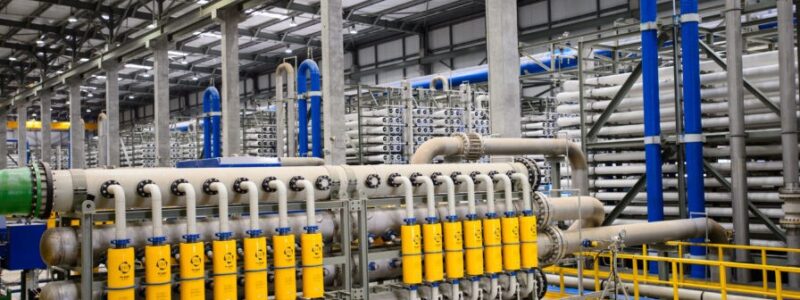
Israel is also actively developing seawater desalination plants. “Currently, three large seawater desalination plants with a capacity of 400 million m3 operate in Israel. Over the next 10 years, 4 more plants will be launched, and processing capacity will grow to 1,200 million m3,” said the designer at Israel's Water Management Authority.
According to Denys Hamzin, Ukraine has great potential to use, first of all, treated wastewater and seawater for agricultural needs. Its large territory makes it possible to choose rational sites for treatment and desalination plants, unlike Israel, where, because of a shortage of land, plants are located not near water sources but where free land is available – sometimes in the center of the country.
Yonatan Tsadka, director of the economic affairs department for Asia and Eurasia at Israel's Ministry of Foreign Affairs, noted that modern water treatment technologies emerged thanks to Israel's policy of developing innovation. According to him, Israel is focused on innovative areas, especially in the circumstances in which Israel finds itself. “There are national plans that allow the entire population to focus on creating breakthrough technologies, which will be very important in the future. One of the driving factors is climate change. In this area Israel has a certain advantage; new challenges strengthen our resilience. Now we have faced issues of migration of foreign workers and changes in supply chains,” said Yonatan Tsadka.
Vitalii Holovnia, deputy minister of agrarian policy and food, noted that the issue of efficient use of water resources and the search for new water sources for irrigation is important for Ukraine. “This is a topical issue in connection with climate change and the loss of the Kakhovka hydroelectric power plant in terms of irrigation and watering. Implementing projects following the Israeli example will make it possible to resolve the issue of food security,” said Vitalii Holovnia.
President of the Chamber of Commerce and Industry of Ukraine Hennadii Chyzhykov noted that Israel is showing one of the best results during the war. “This country's experience will be very useful for Ukraine,” he said.
Israel's Ambassador to Ukraine Michael Brodsky announced that the Watec Israel conference will be held in Jerusalem on September 16–19, 2024. “This is a unique opportunity to see various technologies that have worked for many years in different countries and may be useful for Ukraine,” said Michael Brodsky.
According to the State Agency of Ukraine for Land Reclamation, Fisheries and Food Programs, the destruction of the Kakhovka hydroelectric power plant left 94% of irrigation systems in the Kherson region, 74% in the Zaporizhzhia region and 30% in the Dnipropetrovsk region without an irrigation source for a long time. In total, more than 350 irrigation pumping stations and about 1.1 thousand km of land reclamation canals cannot be used. (source – https://agronews.ua/news/stalo-vidomo-skilky-znadobytsya-chasu-na-vidnovlennya-systemy-zroshennya/)
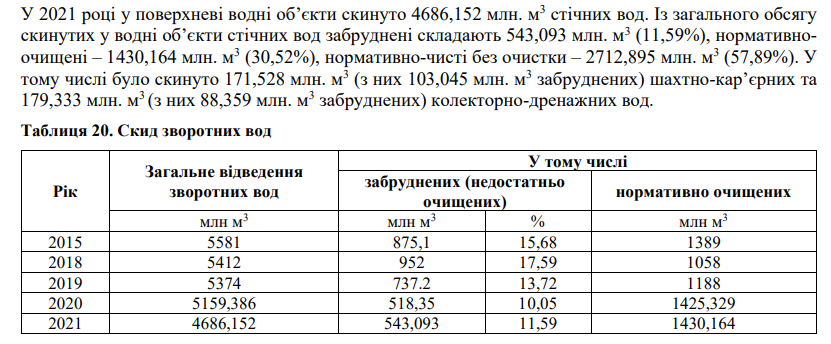
According to the Ministry of Environmental Protection and Natural Resources of Ukraine, in 2021 the volume of wastewater discharged was 4.686 billion m3, of which 58% was normatively clean, 30% normatively treated and 12% polluted. (source – https://eu4waterdata.eu/images/pdf/library/Ukraine_5th_reporting_cycle_UKR_2022_final.pdf)