Successful completion of the Ukraine-wide Barrier-Free Week: from awareness to practical solutions
In May 2026, Ukraine held the All-Ukrainian Accessibility Week — a large-scale inter-institutional initiative that united higher education institutions, government bodies, research institutions, civil society organizations and business partners around a common goal: building a barrier-free environment as an integral part of sustainable development, social cohesion and respect for the dignity of every person. Leading universities of Ukraine joined in organizing and holding the events: Kyiv
In May 2026, Ukraine held the All-Ukrainian Accessibility Week — a large-scale inter-institutional initiative that united higher education institutions, government bodies, research institutions, civil society organizations and business partners around a common goal: building a barrier-free environment as an integral part of sustainable development, social cohesion and respect for the dignity of every person.
Leading universities of Ukraine joined in organizing and holding the events: Kyiv National University of Construction and Architecture (KNUBA), Ivan Puluj Ternopil National Technical University (TNTU), National Technical University of Ukraine “Igor Sikorsky Kyiv Polytechnic Institute” (NTUU KPI), Drohobych National Pedagogical University, National University of Life and Environmental Sciences of Ukraine (NUBiP), National University of Ukraine on Physical Education and Sport (NUFVSU), as well as Kyiv City Employment Service, Veterans Institute, civil society organizations Veterans Cluster of Ukraine (VKU) and Agency for the Restoration of Ukraine.
The week's program covered a wide range of topics — from psychosocial support and the rights of persons with disabilities to practical tools for assessing environmental accessibility, the development of services and the introduction of Smart City principles.
Accessibility as personal experience and a societal challenge
For many participants in the All-Ukrainian Accessibility Week, this topic has not only professional but also deeply personal significance. It is precisely this dimension that is emphasized by Artem Honcharenko, Head of the KNUBA Veterans Institute:
“For me, accessibility is not an abstract concept or a fashionable term. As an ambassador of accessibility and as the son of a veteran with a Group I disability who uses a wheelchair, I know from my own experience what daily barriers are and why they are so painful.
I know what it is like not to be able to simply go out into the city with my father, to visit an establishment or an institution. I know what it means to make titanic efforts just to get into a basic restroom. And that is only the tip of the iceberg — we often do not even speak aloud about many other limitations.
That is why we are not stopping and, as the saying goes, we keep chipping away at this rock. Together with colleagues, universities and partners, we are working systematically on change, and we sincerely believe that our efforts are already beginning to bear fruit. And this is only the beginning — there is still a great deal of important work ahead.”
Barrier-free access, resilience and the recovery of the country
An important intellectual start to the week was participation in the 1st International Conference “Resilient Ukraine: Building an Ecosystem of Mental Health and Psychosocial Support for Resilience, Recovery and Future Development”, which took place on May 25, 2026 at Zhytomyr Polytechnic.
Special attention was paid to the topic “From Trauma to Transformation: Building Resilient Individuals, Systems and Society”, which organically combined the issues of working with veterans, people with disabilities, and the role of educational and state institutions in rebuilding Ukraine.
Education and human rights as the foundation of change
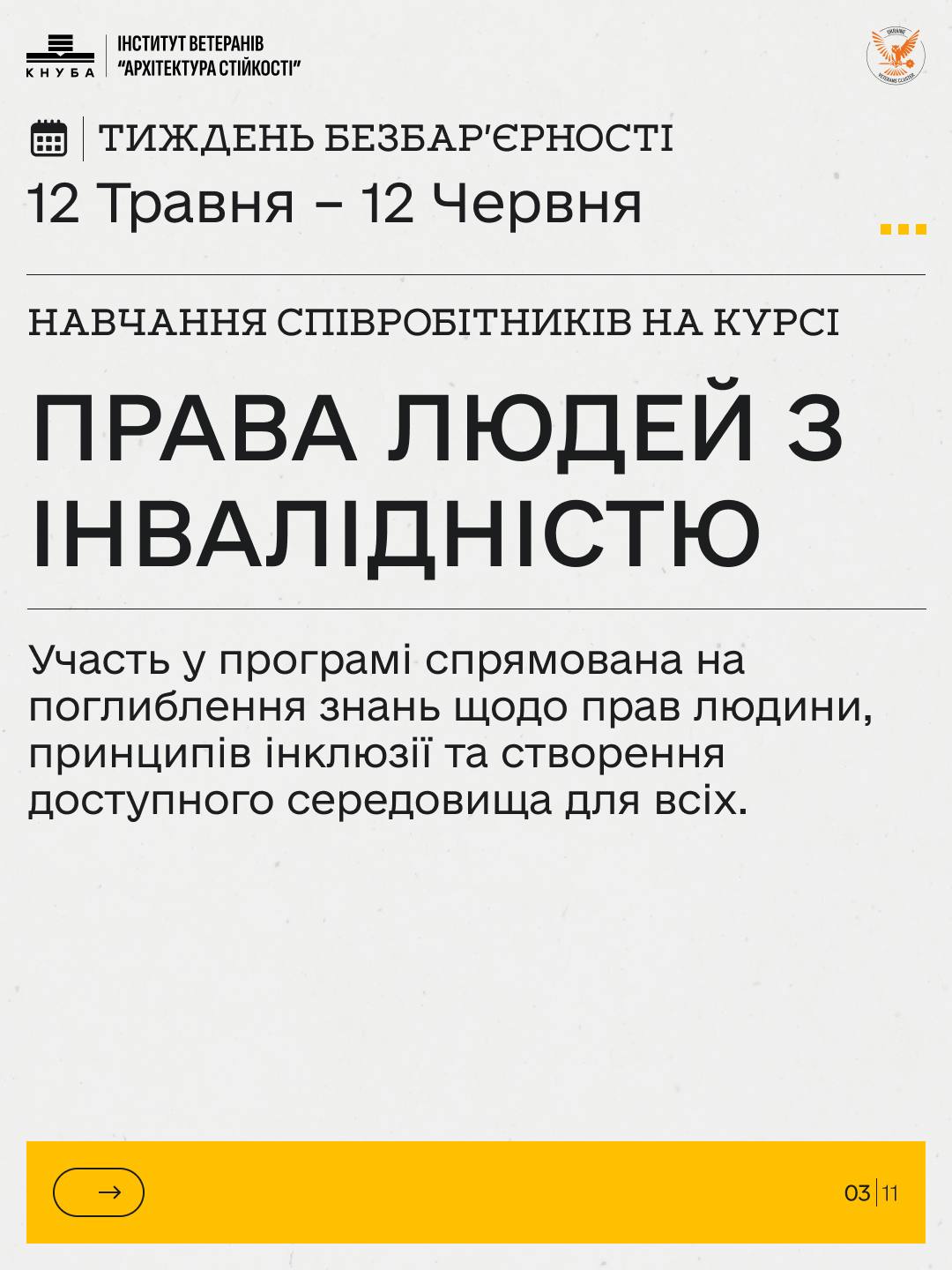
As part of the week, there is also ongoing staff training on the course “Rights of Persons with Disabilities” (from May 12 to June 12, 2026), aimed at building a systematic understanding of the legal, ethical and practical aspects of barrier-free access.
From space to service: practical solutions for barrier-free access
The practical dimension of the week was reinforced by a course on assessing the accessibility of courtyard areas around residential buildings for wheelchair users, which took place on May 26, 2026 in the residential district of Teremky-2 (Liatoshynskoho, Kasiiana and Heroiv Mariupolia streets).
In parallel, together with partner organizations — the Mlyn group of companies and the Shaw architectural bureau — training sessions and surveys of buildings and structures were conducted, and pre-design proposals for KNUBA and NUFVSU were developed.
The strategic role of accessibility is emphasized by Viktor Korzh, head of the Training and Rehabilitation Center of NUFVSU:
“For us, barrier-free access and accessibility are not an additional area but the foundation on which all further work is built. It is precisely this basis that is decisive for providing quality services in the future, both for veterans and for persons with disabilities.”
Digital solutions and Smart City as the future of barrier-free access
The role of digital tools in creating a barrier-free environment was highlighted by Andrii Stanko, coordinator of the Smart City working group from TNTU, noting the link between technology, transport and services.
“The smart city and barrier-free access are closely intertwined… the use of digital resources is our future in building a truly accessible environment.”
Kyiv's CNAPs: barrier-free service, crisis communication and AI
An important component of the week was the one-day training “Barrier-free access: from the foundation to practice,” held at the CNAP of the city of Kyiv (Department of Administrative Services) for the staff of the capital's CNAPs.
The speakers at the event were Artem Honcharenko and Mykhailo Vasianovych. The training focused on working with persons with disabilities, veterans and their families, the specifics of communication in crisis situations, and modern tools for improving service quality.
Special attention was paid to the possibilities of AI tools in the work of CNAP staff and their application in the field of barrier-free access. The discussion also brought out two further important blocks, which are planned to be implemented separately in the near future: security activities and the provision of first aid, in particular what to do in the case of epileptic seizures.
Training that saves lives: first aid and what to do during epileptic seizures
An important part of our initiatives during the Barrier-Free Week was practical training in first aid and initial actions during epileptic seizures, conducted by Denys Boichuk — a specialist with real experience and a clear, accessible way of presenting complex topics.
Barrier-free access is not only about ramps, elevators or correct language. It is also about safety, readiness to help, and not to do harm, when a person nearby ends up in a critical condition. That is why such knowledge should be basic — for staff of educational institutions, administrative teams, students, parents and everyone who works with people.
During the training, participants:
- received clear algorithms of action in emergencies;
- analyzed typical mistakes and fears that get in the way of helping;
- learned how to respond correctly to epileptic seizures, without resorting to harmful myths and dangerous practices;
- understood how to stay calm and support the person until medics arrive.
This training became an example of how inclusion moves from declarations to real skills, and how a barrier-free space begins with prepared people. After all, real accessibility is when those around you know what to do, and are ready to act responsibly.
Barrier-free access is not a once-a-year matter
Summing up the Ukraine-wide Barrier-Free Week, participants emphasized: such initiatives are important markers of society's attention, but real change requires constant work.
This was emphasized by Yevhen Komarov, Ambassador of the “Movement Without Barriers” project, Ministry of Development of Ukraine:
“The Barrier-Free Week is an occasion to remind the whole country of the importance of this issue. But solutions and actions must continue throughout the year — non-stop.”
Outcomes
The Ukraine-wide Barrier-Free Week showed that only a combination of personal experience, professional expertise, digital solutions and cross-sector partnership can deliver real change. The results achieved have become the basis for further action — not ad hoc, but systematic and long-term.
Barrier-free access is not just an event. It is a journey.


