Implementation of the government experimental project on the transition from military service to civilian life
At a round table held at the agency “Interfax-Ukraine” on Tuesday, the results of a pilot project were discussed, developed in close cooperation between the Ministry of Education and Science and the Ministry of Veterans Affairs, with the active participation of the Ministry of Youth and Sports. The experiment consists in giving all war veterans the opportunity to acquire a new profession, improve their qualifications, undergo rehabilitation and take part in sporting events
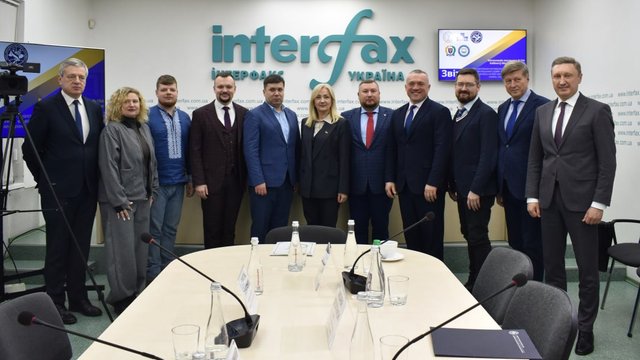
At a round table that took place at the agency “Interfax-Ukraine” on Tuesday, the results of a pilot project were discussed, developed in close cooperation between the Ministry of Education and Science and the Ministry of Veterans Affairs, with the active participation of the Ministry of Youth and Sports. The experiment consists in giving all war veterans the opportunity to acquire a new profession, improve their qualifications, undergo rehabilitation and take part in sporting events at higher education institutions of Ukraine.
“Owing to the hostilities, Ukraine has a high likelihood of becoming the country with the largest number of male and female veterans. According to official data, as of January this year the Ukrainian army numbered about 880,000 service members. And according to the Ministry of Veterans Affairs, the total number of war veterans, family members of the fallen and persons with disabilities as a result of the war in Ukraine exceeds 1.3 million people, and further Russian aggression may lead to an increase in the veteran community,” said Artem Honcharenko, moderator of the conference and head of the Institute of Reintegration, Rehabilitation and Professional Development of Veterans “Architecture of Resilience” of KNUBA.

The new challenges have given rise to new tasks for domestic higher education institutions (HEIs): a need has arisen to create an effective model for integrating war veterans into civilian life through specialized educational, sports and rehabilitation programs.
Through the joint efforts of the participants in the government experimental project, a number of events were held. In particular, KNUBA, as the country’s leading specialized higher education institution, took on a key role in the reintegration of veterans. The university’s specialists joined in developing innovative architectural projects and creating rehabilitation centers and accessible spaces for living, education, work and leisure. The university can become a key partner in shaping a global spatial policy that will ensure comfort, inclusivity and sustainable development for veterans, their families and communities. This is an important contribution to the reconstruction of Ukraine and to creating decent working conditions for those who defend our future.
“Our university influences the market of specialists in construction and architecture, so we actively support projects and initiatives thanks to which more people will strive to create spaces that are accessible and convenient for everyone without exception. Modern approaches to the design and construction of premises, structures and spaces that take into account the principles of inclusivity, barrier-free design and accessibility must become the basis for all educational institutions that train specialists in architecture, construction and engineering. Joining efforts in this direction makes it possible to jointly make a significant contribution to social development. The university institute ‘Architecture of Resilience’ is launching the Veteran Development Center, which will become a platform for the adaptation and support of our defenders and a space for learning, networking and development,” emphasized Oleksii Dniprov, rector of the Kyiv National University of Construction and Architecture.

In addition, representatives of the Kyiv National University of Construction and Architecture and the National University of Physical Education and Sport took part in several stages of the implementation of the project on inclusive recovery of Ukraine, carried out by the School of Universal Design of the United Nations Development Programme with the financial support of the Government of Sweden. Under the project, 70 participants from all over Ukraine were selected, who worked on real projects in 13 Ukrainian cities, creating a wide range of public spaces that must be accessible to everyone, including people with disabilities.
At the same time, the university began working with foreign organizations and institutions on providing medical assistance to war veterans and organizing specialized rehabilitation programs.
“The National University of Physical Education and Sport of Ukraine has demonstrated its capabilities in the rehabilitation of male and female veterans by means of physical education and sport. Sport for war veterans is a new phenomenon both in legislation and in our society as a whole. It requires scientific and methodological development, and in this context our university is one of the centers for the establishment of sport for war veterans and their family members,” noted Oleksandr Pyzhov, acting rector of the National University of Physical Education and Sport.
According to him, the university provides long-term physical education and sports rehabilitation, holds sporting events and training for military personnel and war veterans, which improves their reintegration into civilian life. Over the course of the year, methodological recommendations on providing physical education and sports rehabilitation have been developed, cooperation is under way with leading medical universities and hospitals in Kyiv, a multidisciplinary commission has been set up, and the systematic provision of rehabilitation services has been introduced. Meetings with representatives of the authorities at the national and local levels are held continuously. The university ensures a comprehensive set of measures for social, physical, physical education and sports, and psychological rehabilitation. To ease war veterans’ transition from military service to civilian life, the university offers formal and non-formal professional education and the award of professional qualifications. An adaptive educational infrastructure has been created, which introduces specialized educational methods and the adaptation of educational programs.
This autumn, 14 sporting events were held as part of the project “Sport and war veterans (UBD, participants in combat operations)”; they included such sports as billiards, athletics (running and shot put), chess, sitting volleyball, futsal, wheelchair basketball and others.
Also this year, the All-Ukrainian veterans’ games in esports and CrossFit were held at NUFVSU. This set of events is aimed at the fastest possible return of war veterans to civilian life, and only by joining our efforts will we succeed!
Volodymyr Onyshchenko, rector of the National University “Yurii Kondratyuk Poltava Polytechnic”, reported that, as part of the deepening of cooperation between Ukraine and the European Union, on September 11, 2024 his university became a venue for an important dialogue between veterans, the Nobel Peace Prize laureate and director of the Kharkiv Human Rights Group Yevhen Zakharov, and a delegation of members of the committee of the European Union Advisory Mission for Civilian Security Sector Reform in Ukraine (EUAM Ukraine), the Representation of the European Union (EUDEL), the Poltava Regional Military Administration, heads of territorial communities and public organizations.
“Poltava Polytechnic is adapting the university’s material and technical base to the requirements of an inclusive space. Thus, from October to December of this year, 2,090 war veterans attended a number of events at the university,” the rector added.
“During 2024, rehabilitation services were provided to 170 people affected by the war (comprehensive rehabilitation after limb amputations, after gunshot wounds, after injuries and diseases of the musculoskeletal system and the peripheral nervous system). A project for people with visual impairments has been implemented. Specialists developed a tactile album-catalog of icons, ‘See the treasures together’, with acoustic adaptation. Overall, the implementation of the experimental project is consistent with the plan for the post-war recovery of Ukraine and the development strategy of the Ivano-Frankivsk region for 2021–2027, in particular ‘Development of social infrastructure and inclusion’, and has a high level of priority, since it will promote the social integration and psychophysical rehabilitation of war veterans,” emphasized the rector of the Vasyl Stefanyk Precarpathian National University Ihor Tsependa.

“Physical culture, health-improving and sports activity is one of the key ways of involving war veterans in active social life and professional activity. Our goal is to create the conditions for their social adaptation, physical and mental recovery, as well as psychological rehabilitation. Since the beginning of 2024, the Ministry of Youth and Sports of Ukraine, together with the All-Ukrainian Center for the Physical Health of the Population ‘Sport for All’, has been actively implementing a new social project, ‘Active Parks – Unstoppable’,” said the deputy minister of youth and sports of Ukraine Serhii Tymofieiev.
The goals of the project are to restore general physical condition, strengthen mental health, promote social interaction, and unite war veterans and persons with war-related disabilities into a close-knit community through physical culture and sport.
The “Active Parks – Unstoppable” project is set to become a new stage in the rehabilitation of our veterans. We have already created 85 adaptive clubs where everyone can find something to their liking – from fitness to rugby. The Ministry of Youth and Sports is working to expand the initiative to cover all regions of Ukraine and to give veterans access to high-quality programs for physical and mental recovery.
Also, with the aim of developing adaptive sport, twenty-six federations for sports recognized in Ukraine have already integrated an adaptive sport component into the rules of sports competitions.
“Involving war veterans in physical culture and sport is today an important component not only of their physical and mental recovery, but also of their social adaptation; it helps overcome barriers and restores confidence in their own abilities. This experiment on the basis of higher education institutions will contribute to building a systematic approach to the recovery and socialization of veterans at educational institutions through sport, will help build inclusive conditions for Ukrainians with special needs, and will strengthen their participation in the sporting and active life of the country. In this context, the development of adaptive sport is of particular importance today, as it is meant to enable every beneficiary to feel supported, find new opportunities, and return to an active life. We want every veteran to be able to feel supported, find new opportunities, and return to an active life. Physical culture and sport help not only to restore health, but also to find new goals,” emphasized Serhii Tymofieiev.

The Educational and Scientific Center for Socio-Psychological Support and Resilience of the West Ukrainian National University holds psychological trainings and consultations, art therapy workshops, and various creative events to support emotional balance and develop resilience among veterans and their family members; it also organizes screenings of documentaries about the defenders and meetings with the veteran heroes of the films, among other activities. This was reported by the university rector Oksana Desiatniuk.
“Our university has opened the first immersive multifunctional hub in Ukraine. This project is part of the National Strategy for creating a barrier-free space by 2030, initiated by the first lady of Ukraine, Olena Zelenska. The hub has launched a project for the psychological rehabilitation of veterans and the physical rehabilitation of the upper limbs using Webex Hologram and Magic Leap 2 augmented reality glasses. Particular attention is paid to training personnel and improving the qualifications of academic and teaching staff who work with veterans,” she added.
Ukraine's deputy minister of education and science Andrii Vitrenko stressed that, despite the war, the number of foreign students at higher education institutions in Ukraine remains significant. He also emphasized the need to further improve conditions for international students in Ukraine.
“The implementation of this experimental project, launched on the instructions of the President of Ukraine, Volodymyr Oleksandrovych Zelenskyy, has demonstrated the enormous potential of universities as leaders and reliable partners in implementing veterans policy. Five leading higher education institutions have created unique methods that help war veterans reintegrate into civilian life through education, sport and rehabilitation programs. This project has developed an effective methodology that must be extended to other universities. The social responsibility of higher education institutions lies in introducing such technologies and methods into their daily work. Currently, about 27 thousand foreign students study in Ukraine; before the full-scale invasion there were about 80 thousand, and the peak number of foreign students reached about 100 thousand. In terms of price-quality ratio, Ukrainian education holds a leading place among the top three European countries. I am confident that after the victory we will reach the largest number of foreign students at our universities and will also meet the demand of domestic students for education. I thank all participants for their dedication and their desire for change!” he noted.
Director of development at the Interfax-Ukraine news agency Maksym Urakin, for his part, stressed the need to implement the results of the experiment and to establish budget funding for helping citizens adapt to peaceful life.
War veterans today are facing precisely this unique phenomenon of “job hunting” on the Ukrainian labor market. Employers today must, and are able to, provide every veteran with any kind of work under appropriate conditions in line with their needs and physical abilities. Assistance to a special segment of the population – our defenders – must be unconditional and qualified. Any support is important, especially from the state.
That is why new opportunities for veterans and their families are being actively created at educational institutions. Special courses have been developed in close cooperation with employers, the public and representatives of veteran communities. This is a chance to gain new knowledge and skills that will help them return to their chosen profession in civilian life after coming back from the front.
Summing up the conference, the joint experimental project involving the participating universities has produced high and positive results, which means that the project should go on, and from next year systematic and coordinated work must be built on a permanent basis.