Business brunch “Strategy. Energy. Responsibility”: business that shapes the future of Ukraine
On March 24, 2026, at the “Veranda na Dnipri” restaurant, the business publication “Pershyi Biznesovyi | BIZ” gathered representatives of big business, executives, experts, and opinion leaders. This was an event about something more than business. About responsibility. About strength. About the people who today keep the country's economy running. In difficult times, it is business that becomes the pillar of the state — through taxes, jobs, social initiatives
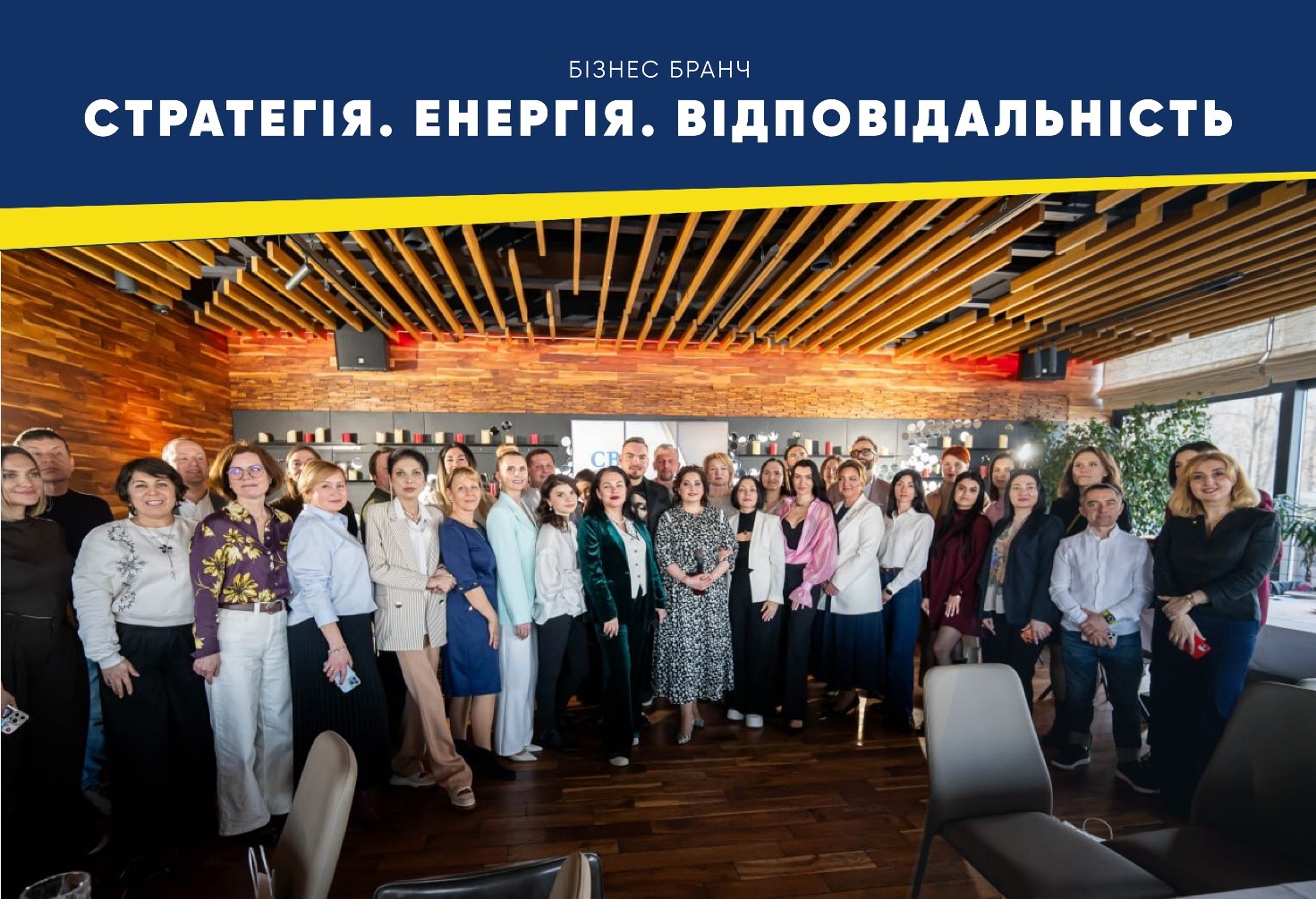
On March 24, 2026, at the restaurant “Veranda na Dnipri”, the business publication “FIRST BUSINESS | BIZ” brought together representatives of big business, managers, experts, and thought leaders.
This was an event about something more than business. About responsibility. About strength. About the people who today carry the country's economy.
In difficult times, it is business that becomes the backbone of the state — through taxes, jobs, social initiatives and real actions. And those who gathered on this day are businesses lending their shoulder to Ukraine.

Symbolically, nature itself supported the event: the first truly spring-like day added bright colors. Even the air was charged with hope — a reminder that even in difficult times for the country, new stages, new partnerships, and new solutions begin.
The event was opened by Kateryna Tyria — HRD of Veranda / Fenix restaurants, with a topic that resonates with thousands of women — how to find a balance between career, family and social activity.

According to her, the main mistake is to perceive these areas as separate. In fact, they are interconnected and reinforce each other.
“Career, family and social mission are not three different lives. You are one person, and these roles cannot exist separately,” the speaker emphasized.
One of the key emphases of the speech is the woman's inner state. If she is exhausted, this is reflected both at work and in the family.
“When a mother has no resource left, the children have none either. When a leader has no resource left, the team doesn't work,” notes Kateryna Tiuria.
That is why self-care is not an option but a necessity for effectiveness in all areas of life.
As part of the business brunch, a panel discussion took place, “Media, PR and Reputation: How to Communicate in an Age of Distrust”, which brought together leading experts in communications, media and corporate reputation.
The moderator was Dmytro Chepur, head of the special projects department at Mind UA.

The modern information space is characterized by a high speed of information dissemination, where any case instantly becomes a subject of public discussion.
The participants noted: today communication strategies are constantly tested for resilience, and only those brands that are able to adapt strengthen their reputation.
Among the key ones:
- YouTube — as the leader in reach;
- TikTok as a tool for rapid organic growth;
- Threads — as an environment for live brand interaction;
- Telegram and the media — as sources of trust.
At the same time, classic tools such as press releases or websites remain effective only if properly adapted to new digital algorithms and user behavior
At the center of the discussion is communication compliance as a system for crisis prevention.
The experts emphasized:
- up to 80% of crises can be predicted;
- the synergy of legal, financial and communication functions is critical;
- business must work proactively, not just react.
Valentyna Yovenko, Director of Corporate Communications at the “Apteka 9-1-1” chain, emphasized that crisis communication today is no longer a separate function, but the daily reality of business.

“Anti-crisis work is not something that will happen someday. It is what we deal with every day,” she stressed.
According to her, an effective in-house team must act systematically and be ready for challenges at any moment. Among the key elements:
- clear internal response protocols;
- a library of messages prepared in advance;
- constant monitoring of the information space;
- the ability to decide — to respond or to consciously choose silence.
She separately emphasized that messages backed by real business actions are becoming decisive.
Among the key areas of communication:
- support for frontline territories;
- development and training of employees;
- work with youth;
- support for teams and their families;
- systematic charity.
"It's important not just to talk, but to act systematically," — summarized Valentyna Yovenko
She paid special attention to the fact that reputation is formed not at the moment of a crisis, but daily — through the real actions of a business, social initiatives, and support for employees.
At the same time Dmytro Samoliuk, Head of Digital “My – Ukraina”, “My Ukraina+”, emphasised the new rules for brands' presence in the digital environment.
According to him, a company's visibility today depends directly on the quality of its content, its optimisation and the number of mentions in the information space.
“For content to work and to be ‘picked up’ in the information space, proper optimization and a sufficient number of citations are needed. Large brands have an advantage here, but it is also possible for small businesses,” he noted.
He named the integration of artificial intelligence into information consumption as a separate trend.
“We are already seeing advertising being integrated directly into AI responses. And at some point, the user may not be able to distinguish between a recommendation and an advertising integration,” the expert emphasized.
Thus, modern business communication is formed at the intersection of two key factors:
- systemic internal readiness for crises;
- the ability to work in the new digital reality, where algorithms and AI become part of the communication strategy
Uliana Kolodii, founder of the communications agency u.comms, emphasized that most reputational crises are not accidental — they can be anticipated at the strategic planning stage.
“Up to 80% of crisis situations can be predicted — and this is precisely a matter of compliance processes within a company,” she noted.
According to her, communication compliance is a much broader concept than just PR. It covers:
- the legal component;
- the financial function;
- the ESG dimension (ecology, social responsibility, governance);
- product quality and consumer behavior.
The key condition for effectiveness is the interaction of three functions — a lawyer, a communications professional, and a financier: it is precisely this synergy that allows businesses to make balanced decisions in crisis situations.
At the same time, she emphasized that the combination of internal and external expertise remains the most effective model.
“In-house teams have a deep understanding of the business, but in a crisis it is important to maintain objectivity — and here the role of external specialists becomes critical,” she noted.
Nataliya Kholod, founder and CEO of the VARTO agency, drew attention to the change in approaches to communication in the new information reality.
According to her, the key task of a business is not simply to choose a channel, but to understand exactly how the audience consumes information.
“Today it is important not only where to communicate, but how to deliver information and how the consumer perceives it,” she noted.
She emphasized that modern communication is formed around:
- real channels of information consumption (social media, Telegram, email, AI);
- the correct presentation of content — both for the audience and for algorithms;
- presence in quality media as a tool of long-term influence.
Separately, Natalia Kholod emphasized the role of agencies in crisis situations.
External teams allow:
- keep a “cool head”;
- not overestimate the scale of the problem;
- make strategic, not emotional, decisions.
“In a crisis, it is important to step back from emotions and look at the situation from the outside. This is often what saves a business's reputation,” she emphasized.
A separate part of the program was the speech of Olena Krekniina — deputy marketing director of AXOR INDUSTRY on the topic: "Made in Ukraine: Ukrainian manufacturing as a driver of economic reconstruction. The role of industrial companies in job creation, export development, employer responsibility, and the recovery of Ukraine's economy."
In her speech, she emphasized that Ukrainian manufacturers today are not just competing with international brands, but are also forming a new level of trust in the Made in Ukraine brand

One of the key areas of development is export. Over the past few years, AXOR INDUSTRY has raised its share from 4% to 45% and entered 27 countries, confirming the competitiveness of Ukrainian business at the global level.
At the same time, people remain the foundation of development. The company invests in the team, employee development, and the formation of an internal brand, because it is the employees who become the ambassadors of the business.
A separate focus is on education and personnel training:
- cooperation with educational institutions;
- support for youth and veterans;
- creating new educational opportunities.
Social responsibility is integrated into business processes — from charitable initiatives to products that enhance safety.
Ukrainian manufacturing is the foundation for rebuilding the economy through jobs, exports, innovation, and responsible business.
As part of the event, the speaker was Maryna Zavoloka — HR Director of Octava Capital with the topic: “Managing People in Wartime: Motivation, Stability, and Trust in the Team”.

In her speech, she emphasized that today people are simultaneously the most valuable and the most vulnerable resource of business. Ukraine's labor market is undergoing a deep transformation — according to various estimates, the country has lost between a third and half of its workforce, creating a systemic staff shortage.
In these conditions, employees' key demand is not only financial factors but, above all, stability, safety, and support from the company. At the same time, the basis of any motivation remains decent pay — without it, neither values nor corporate culture work.
Maryna Zavoloka paid special attention to the role of caring for the mental and physical health of teams. Modern companies must create safe working conditions, introduce flexible employment formats, provide medical insurance and access to psychological support.
She named the transition from reactive to proactive management as the key approach in working with teams — when a business does not react to a crisis, but builds in advance a system capable of withstanding challenges.
Among the tools that allow this to be implemented:
- systemic analytics that helps anticipate risks and understand team sentiment;
- assessment of employee potential and formation of an internal talent pool;
- the development of managers as key carriers of management culture.
According to her, it is managers who play a critical role today: people join companies for the brand, but stay or leave because of their direct manager. Therefore, a leader in modern conditions is not a controller but a support for the team.
Summing up, Maryna Zavoloka noted that business resilience today rests on five key elements: decent pay, analytics, development of employees' potential, strong management and systematic support for teams.
It is these factors that build trust — the main foundation of business stability and development in wartime.
At the business brunch, the speaker was Liubov Pidhorna — co-founder of LLC MSP (TM Fines) with the topic: “Customer loyalty as a business growth strategy”.
In her speech, she emphasized that customer loyalty is not an abstract concept, but systematic business work that directly affects financial results.

The key message: the customer is, above all, a person with their own emotions, burdens, and choices. And it is precisely through emotional experience that true loyalty is formed.
According to her, modern business must work simultaneously in two directions:
- attract new clients;
- retain existing ones, since in a shrinking market this is equally critical.
She paid special attention to practical tools for building loyalty:
- creating an emotional experience for the customer;
- personalization of communication;
- regular and systematic contact;
- ease of interacting with the brand;
- unexpected pleasant gestures.
It is precisely these factors that build trust, which over time transforms into long-term relationships.
Separately, Liubov Pidhorna emphasized the importance of a systematic approach: loyalty does not work as a one-off action — it is a strategy that must be built into the annual communication plan.
“Consistency builds trust, and trust builds loyalty,” she emphasized.
According to her, emotional contact with the customer is often more effective than purely rational incentives.
Practice shows that customers remember not the product, but the feelings they experienced when interacting with the brand — and this is exactly what influences repeat sales, recommendations, and future choices. Summing up, she noted: customer loyalty is not an expense, but an investment that pays back through trust, repeat sales and stable business growth.
Panel discussion “Strategy, Responsibility, and Trust in the New Economy”
Moderator: Nadiia Shuliak — investment consultant, attorney, managing partner of the law firm “Kraun”
Participants:
- Andriy Dligach — Doctor of Economic Sciences, Professor, founder of Advanter Group and the international business community Board;
- Kateryna Kuzmina — Head of Procurement and Sustainable Development at AB InBev Efes Ukraine;
- Natalia Yemchenko — Director of Public Relations and Communications at SCM.

The discussion focused on approaches that allow businesses to adapt to constant uncertainty and shape Ukraine's new economy through strategy, transparency, and partnerships.
Her vision was shared by Kateryna Kuzmina is head of the procurement and sustainable development department at AB InBev Efes Ukraine.

She emphasized that uncertainty for business is not a new phenomenon, but an already familiar reality shaped by years of crises, policy shifts, the pandemic, and disrupted logistics chains.
Under these conditions, the key approach is scenario thinking — having plans A, B, C and D, as well as relying on long-term partnerships that ensure business resilience.
She paid special attention to transparency in procurement. According to her, it starts with a correctly formulated need: if the request is open and flexible, the market offers better solutions and creates additional value.
“Procurement is not only about costs, but about efficiency and results for the business,” she noted.
She also emphasized that in cases where a company “buys into the idea,” direct partnerships or exclusive contracts are possible — but only on the basis of trust.
A separate emphasis was on the role of the team. A strong leader does not do the work for people, but creates an environment where the team takes responsibility and works toward a shared result.
Business resilience today is partnership, transparency and a team that works as a single system.
Andrii Dligach — founder of Advanter Group and the international business community Board, emphasized that one of the key problems for business remains a deficit of trust — companies often act according to the logic of “getting ahead before being deceived,” which destroys partnerships. Instead, business should move toward a new paradigm — uniting around the future rather than focusing on the past.

According to him, the modern economy is transforming from competition to cooperation.
In the new reality:
- openness is becoming the norm;
- closed models no longer work;
- those who develop faster than they are copied win.
He also noted that loyalty as a tool is weakening — instead, the role of experience, emotions, and value for the customer is growing.
Classic approaches to teams are changing — flexible, project-based work formats are coming to the fore. At the same time, the modern world increasingly operates according to a “game” logic:
people choose what engages them, gives interest and a sense of participation.
Strong business today is openness, collaboration, and the ability to unite people around a shared future.
In his speech Nataliia Yemchenko — director of public relations and communications at SCM — suggested looking at war and crisis through the lens of trauma: as a phenomenon that can not only destroy but also become a resource for growth. According to her, trauma is ambivalent: it can lead both to losses and to development — it all depends on how one works with it.

She emphasized that it is important for business to accept the new reality: a return to “how it was” is no longer possible. Instead, forming a vision becomes key — the ability to see oneself in the future and move toward it. It is exactly this that turns a crisis into a point of growth.
Nataliia Yemchenko paid special attention to the topic of trust. She emphasized that trust is not only a value but an economic factor: its absence directly increases business costs, complicates partnerships, and limits development opportunities.
As a metaphor, she cited "fences" and "bridges": fences represent distrust and isolation, while development is only possible through building connections and cooperation.
She also emphasized that modern business is moving toward a more flexible model — through delegation, partnerships and horizontal connections.
A particular emphasis is placed on the team. According to her, what becomes key is not only professional skills, but value compatibility and the ability to take responsibility. Strong professionals without shared values can deliver short-term results but strategically weaken the business.
The future of business is trust, partnership, and the ability to turn crisis into a resource for development.
The business brunch program also featured a speech by Liliia Oliinyk — businesswoman, public figure, founder of the ilive brand with the topic: “Children of the Future: How Upbringing Today Shapes Tomorrow's Business Culture”.
In her speech, she emphasized that the future of business is not shaped in companies, but much earlier — within the family. It is through raising children that the values are laid down which later determine the management style, the level of responsibility, and the culture of interaction in business.

According to her, personality formation begins even before birth, since the state of the parents, their thoughts and emotions, directly affect the future child. At the same time, children do not perceive words as the main tool of upbringing — they copy the behavior, reactions, and attitudes of adults toward life and work.
Liliia Oliinyk paid special attention to the basic principles of communicating with children: communication should take place “eye to eye,” in a calm and respectful tone, with emotional stability and in a safe atmosphere. This is what builds trust and openness.
She emphasized that entrepreneurial thinking is also formed from an early age — through the opportunity to take initiative, make decisions, make mistakes and draw conclusions. At the same time, the modern education system does not provide these skills in full, so the responsibility for developing them lies with parents.
The emotional state of adults also plays an important role: parents' confidence and calm give a child inner support and a sense of security.
She placed particular emphasis on the fact that the most valuable investment is investment in children — through shared time, the transfer of experience, and involvement in real life. Children should be part of the world of adults, see how their parents work, and understand the value of labor.
Summing up, Liliia Oliinyk noted: the future of business is being created already today — in daily conversations, decisions, and interactions with children who are shaping a new generation of leaders.
The closing speech of the event was the presentation by Artem Honcharenko — head of the Veterans Institute "Architecture of Resilience" at KNUBA. on the topic: “Experience of cooperation with the USA and programs to be implemented in Ukraine in 2026–2030”.
In his speech, he emphasized that the issues of rehabilitation and integration of veterans are today not only a social challenge but also a strategic task for the state and business. After all, supporting veterans means supporting families, preserving human capital, and strengthening the resilience of society.

He shared practical experience of cooperation with the USA, in particular through veterans' sports as a tool for rehabilitation. According to him, the participation of Ukrainian veterans in international competitions not only contributes to physical recovery but also creates a new quality of international communication — the so-called “soft diplomacy.”
Special attention was paid to launching new joint initiatives. In particular, the creation was announced of of the Ukrainian-American Research Institute, which will study the impact of the war on the health of the population, including neurological and psychophysiological consequences.
Artem Honcharenko emphasized that cooperation with the US opens new opportunities for Ukraine:
- exchange of experience in the field of veteran rehabilitation;
- engagement of international experts and doctors;
- development of adaptive sports;
- support for Ukrainian programs through partnerships and humanitarian initiatives.
At the same time, he emphasized that Ukraine is not only gaining experience but also sharing its own unique practices — particularly in the field of recovery from combat trauma and the adaptation of veterans under the difficult conditions of war.
Summing up, he noted: the future of veteran support programs lies in international cooperation, knowledge exchange, and a systematic approach to rehabilitation, which will become one of the key directions for Ukraine's development through 2030.
The event's host — Maria Skyba, host of the “My — Ukraina” and “My – Ukraina +” channels, journalist

Event partners
Veranda on the River — A legendary restaurant with an incredible view of the Dnipro and an exquisite atmosphere. A harmony of taste, style and emotions.

Maison Castel — become explorers of the French lifestyle together with Maison Castel! Immerse yourself in an authentic atmosphere of luxury and pleasure while discovering this refined taste.

AB InBev Efes Ukraine — one of the leaders of the Ukrainian beer market.

AXOR Industry — a leading Ukrainian manufacturer of window and door hardware.
Octava Capital — one of the largest investment companies in Ukraine.
The “Apteky 9-1-1” pharmacy chain — has been providing Ukrainians with quality medicines for 29 years, operates in frontline areas, implements social initiatives to support the most vulnerable, and invests in the development of pharmacists.

MSP (Maisternia Servisu ta Podarunkiv) The Finest brand turns corporate gifts into a tool of trust, care, and resilient business relationships.
Avalon — your water, your rules. Drinking water from an artesian well with an unmatched taste and an optimally balanced composition.

Primax — a technology platform for digital agencies and in-house marketing teams.
Veterans Institute “Architecture of Resilience” of KNUBA— an educational, research, and rehabilitation platform to support veterans, internally displaced persons (IDPs), and their families.
Information partners of the event:
TV channel “Mi-Ukraina+,” The business publication Mind, The “Priamyi” TV channel, RBC Ukraine, Media holding “Apostrof». Comments, Delo.ua, 33 kanal, TV channel “My-Ukraina”, Media company FM-TV, Dilova Stolytsia, Cabinet Boss, FEMIDA.UA, Studio of my Dreams, GLORY Magazine, Best People Club, STAR BROTHERS, BUT.IN.UA, Super Lady», Infovision, Dilovyi PRO,
The business brunch “STRATEGY. ENERGY. RESPONSIBILITY” became a platform for a substantive conversation about what truly determines the country's future today: strong business, responsible leaders, trust, people, partnerships, and the readiness to act not only in the interests of their own companies, but also in the interests of Ukraine.
It is precisely this kind of business that today does not just operate — it shapes the future.