Creative exams have begun: veterans are applying to KNUBA
The admission campaign is in full swing at the Kyiv National University of Construction and Architecture (KNUBA) – creative competitions for applicants began in early July. Among those taking exams this summer are Ukrainian defenders. In particular, the veteran Vadym Honcharenko and several of his comrades-in-arms have decided to enroll at KNUBA. They chose modern and in-demand fields such as architecture, industrial and civil engineering (PTsB), physical
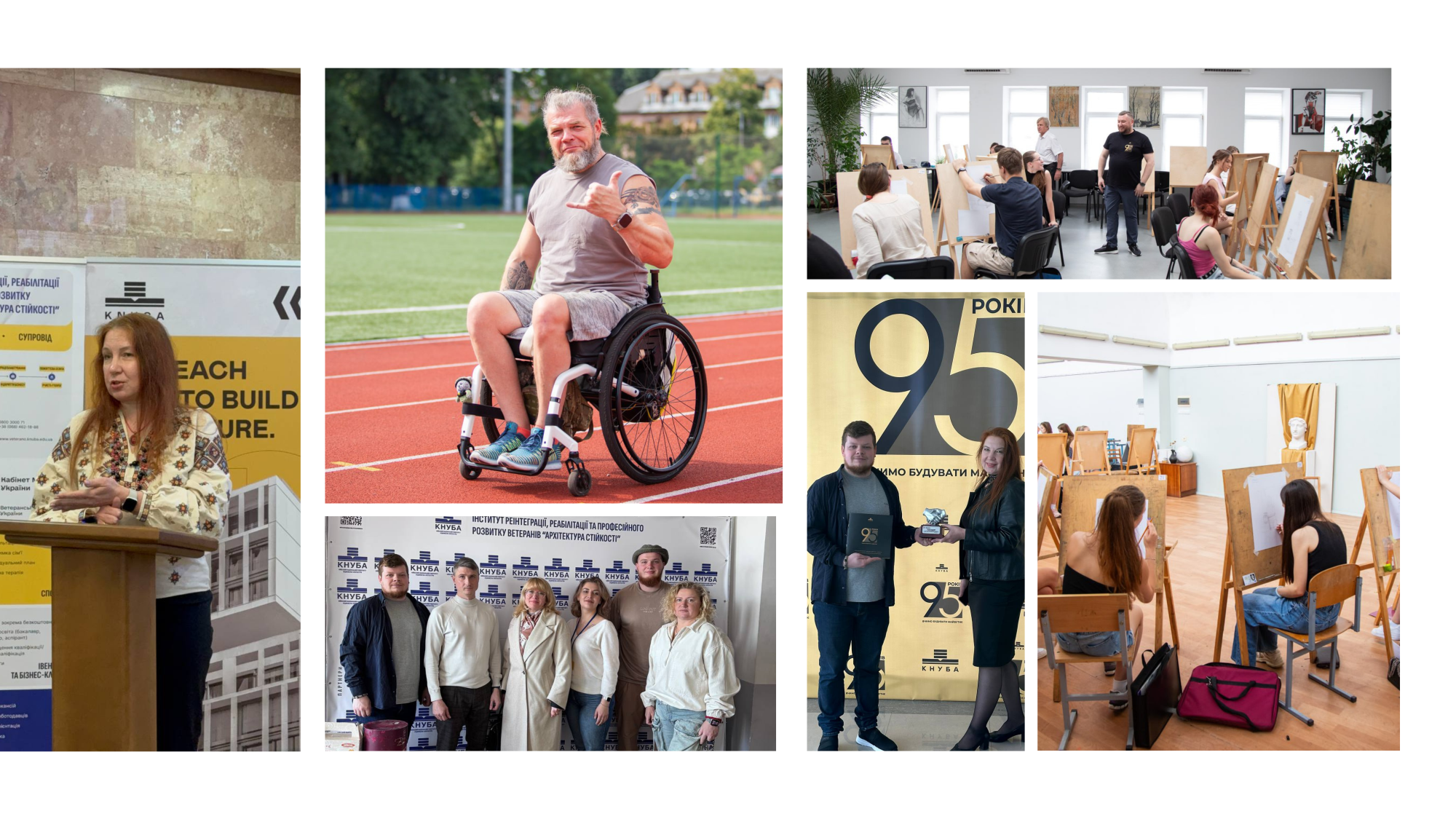
The admission campaign is in full swing at the Kyiv National University of Construction and Architecture (KNUBA) – creative competitions for applicants began in early July. Among those taking exams this summer are Ukrainian defenders. In particular, the veteran Vadym Honcharenko and several of his comrades-in-arms have decided to enroll at KNUBA. They chose modern and in-demand fields such as architecture, industrial and civil engineering (PTsB), physical education and sports (coaching), cybersecurity, as well as a field to which the university pays particular attention – ecology and environmental protection technologies (TZNS). According to the veterans, they fully understand the importance of higher education and retraining: new knowledge will help them contribute to the great reconstruction of the country and find their place in peaceful life. Vadym Honcharenko, who uses a wheelchair, notes that continuing his studies is both a challenge and an opportunity for him. For the university and the Veterans Cluster of Ukraine, this case highlights the relevance of issues of accessibility: funding is currently being sought jointly to adapt the educational environment to the needs of students with disabilities.

“The war will end sooner or later, but education and reconstruction will certainly remain. We must prepare for this right now”, said Natalia Honcharenko, head of the Veterans Cluster of Ukraine, citing a well-known thought about the inevitability of peace and development. As the leader of a veterans' organization, she stresses the need to invest in veterans' knowledge today. Natalia added that the admission campaign is still under way, and those who wish to obtain a master's degree on a state-funded basis still have a chance to submit their documents – the state and partners provide veterans with separate funding opportunities for study. Through the efforts of the Veterans Cluster and KNUBA, with the support of business partners, a program of special scholarships for veterans and their families. The first benefactor of this initiative was the company Axor Industry. At a recent event dedicated to the launch of the reintegration program Re:Veterans Platform, Axor's deputy marketing director Olena Kreknina presented a program of employer cooperation on internships and job placement for veterans. As a representative of the stakeholders, Olena is preparing to teach at the university from the next academic year in order to pass on her experience directly to veteran students.

These innovations are being introduced in line with the state policy of supporting defenders. On July 11, KNUBA and the Ministry of Veterans Affairs signed a memorandum of cooperation, which expands opportunities for the education and professional adaptation of male and female veterans of Ukraine. “For the university, the veterans’ track is a response to one of the country’s main challenges. We help veterans acquire a new profession and return to civilian life with up-to-date knowledge and skills”, stressed KNUBA rector Oleksii Dniprov. According to Yuliia Kirillova, the deputy minister for veterans affairs, combatants and their family members can now obtain a master's degree free of charge at KNUBA, as well as obtain another specialty on the basis of a previously earned diploma. In addition, veterans and their children can study at the colleges affiliated with the university under the state program (Resolution No. 432 of the Cabinet of Ministers). The university, for its part, provides the Ministry with expert support in building modern veterans' infrastructure. In particular, specialists from KNUBA and the Institute for the Reintegration of Veterans «"Architecture of Resilience"» have been involved in developing the concept of “veteran spaces” – a network of multifunctional centers supporting veterans and their families. We recall, that KNUBA students who are children of veterans can already receive compensation for a year of study. All these steps are intended to ensure our defenders a smooth transition from military service to a successful civilian career.

Veteran reintegration: employment and entrepreneurship after the war
The Veterans Cluster of Ukraine emphasizes: the most important result of all educational initiatives is an employed veteran (and his or her family) or a veteran entrepreneur who has started his or her own business. The goal is not merely to earn a diploma, but for defenders to become economically independent and successful in peaceful life. Global experience confirms that integrating veterans into the economy through education, work or entrepreneurship gives a powerful boost to a country's development.
- After WWI (UK): the government introduced a program supporting higher education for former servicemen. In 1919–1923 there was in operation the Scheme of Higher Education for Ex-Servicemen, under which about 28,000 veterans in England and Wales received grants to study at universities. It was an unprecedented step that effectively doubled the student body compared with the prewar period and laid the foundation for the postwar system of university grants.
- After WWII (USA): the legendary “GI Bill” – a law on benefits for veterans – was passed. Thanks to this program, almost half of the 16 million American veterans of WWII received education or vocational training at public expense. This large-scale investment project spared the country postwar unemployment and laid the foundation for an economic boom. Many military graduates not only built successful careers but also started their own businesses – by some estimates, 49.7% of US veterans after WWII became business owners or managers, and after the war in Korea, about 40%. This is how millions of jobs came about, created by veteran entrepreneurs for their generation. In 1990 George H. W. Bush, then president, noted that the GI Bill changed the lives of millions, “replacing old barriers with pathways to opportunity”.
- Postwar reconstruction (UK): Britain too placed its bets on education and social support for the demobilized. A system of state scholarships was created, known as the Further Education and Training Scheme (FETS), which covered the study costs of all former servicemen who wished to enroll. As a result, annual university admissions in the country rose from ~50 thousand (before the war) to 80 thousand after the war. Veterans acquired new professions – engineers, architects, teachers – and joined the rebuilding of the economy at all levels. This social elevator significantly increased social mobility and allowed talented people, regardless of background, to fulfill their potential after the war.
- Israel – “Startup Nation”: compulsory service in the Israeli army became the foundation for the phenomenal rise of the country's high-tech business. Israel now has the largest number of startups per capita in the world and record volumes of venture capital. The cult of enterprise and innovation there has in many ways been shaped by veterans of the IDF. Former servicemen, in particular graduates of elite units such as Unit 8200, apply the leadership, teamwork and non-standard problem-solving skills acquired in the army to business. It is not only Unit 8200 – veterans of various specialties found companies in cybersecurity, programming and engineering. Veteran startups have become the driving force behind Israel being called the “startup nation”. According to Israeli investors, army service accustoms young people to responsibility, persistence and creativity – precisely the qualities an entrepreneur needs. As a result, the state gains a powerful layer of educated business leaders hardened by the experience of service.

Examples from around the world show that by investing in veterans' education today, society gains not only socially protected heroes but also new professionals, managers and innovators capable of developing the economy. “Veterans are not only a force that protects, but also a force that builds”, emphasize at Axor, a company that supports veterans' initiatives. The main task is to help defenders realize their potential in peaceful life. In Ukraine this philosophy is already being put into practice through retraining programs, partnerships with business and support for entrepreneurship among former servicemen. After all, every employed veteran or successful veteran-run business is not only a personal victory for the soldier, but also a contribution to the sustainable development and recovery of the country.
REMINDER:
📢 Education for veterans, defenders and their children — at universities of Ukraine!👀
Veterans Institute “Architecture of Resilience” opens up opportunities for:
✅ Free education* in more than 30 specialties and >100 educational programs
✅ Retraining, courses, a second degree, master's and doctoral studies
✅ Psychological support and rehabilitation
✅ Participation in projects for the reconstruction of Ukraine
✅ Partnership programs with employers (Axor, Barks, Google, Microsoft, Cisco and others)
🎯 Study formats: full-time, part-time (distance), online.
🎓 We work with communities across Ukraine.
📍 Individual support from admission to employment.
💡 We invite everyone to online or offline meetings with our team. We will tell you:
▪ how to submit an application
▪ what benefits veterans and their children are entitled to
▪ how to obtain compensation for tuition
▪ which educational programs are most relevant for reconstruction
Program details:
👉 www.Veterano.info
📩 Write to us or leave a request on the website:
📞 +38 073 94 96 179
📞 +38 050 22 35 182
📞 +38 067 49 81 098
📩 center@uvc.in.net
📩 veterano@knuba.edu.ua
📞 Head: Artem Honcharenko – +38 073 177 72 73
Together we build the future. Start with education today!
Participating partner universities:
- Kyiv National University of Construction and Architecture
- National University of Physical Education and Sport of Ukraine (NUFVSU) — the key institution on whose basis the educational and rehabilitation center for veterans was created.
- West Ukrainian National University
- Yuri Kondratyuk Poltava Polytechnic National University
- Vasyl Stefanyk Precarpathian National University
- National University of Life and Environmental Sciences of Ukraine
- Drohobych National Pedagogical University
- Ternopil Ivan Puluj National Technical University
*“Free education” means participation in state compensation programs, grants, scholarships and support from employers.
Important: admission takes place during the main admission campaign within the standard deadlines.