From Surgical Intervention to Financial Education: How Support for Veterans in Their Recovery Is Being Implemented in Ukraine.
The journey of a Ukrainian serviceman after a serious injury is not just weeks in hospital. It is a long and often exhausting path that begins with surgery, goes through months of recovery and ends with a return to ordinary life: looking for work, adapting to new conditions and dealing with…
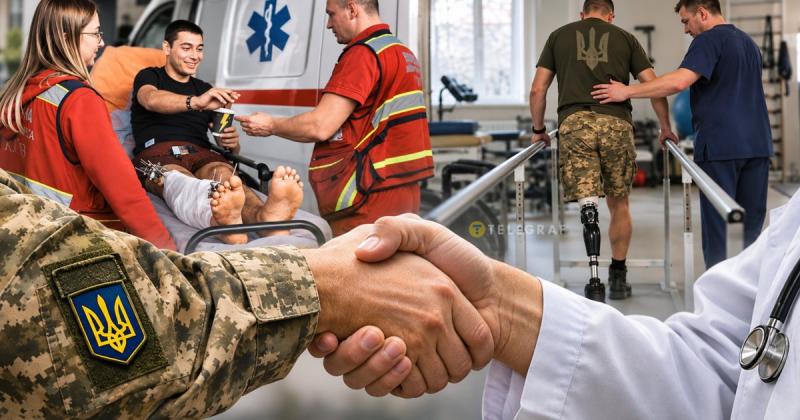
The journey of a Ukrainian serviceman after a serious injury is not just weeks in hospital. It is a long and often exhausting path that begins with surgery, goes through months of recovery and ends with a return to ordinary life: looking for work, adapting to new conditions and dealing with everyday matters.
So that a person is not left alone with his difficulties on this path, coordinated cooperation among all participants is needed: military medics, charitable organisations, representatives of the state and business. Each of them plays their part in the overall process. How does this system function, where do the most serious problems arise, and why is one-off assistance no longer effective? You will find the answers to these questions in the article by “Telegraf”.
Injury and the First Link
Modern technologies in military conflicts have significantly transformed the nature of the injuries that medical workers face. Whereas previously doctors more often encountered isolated limb injuries or gunshot wounds, the situation has now changed dramatically.
Combined injuries are the most complex because they affect not only the limbs but also the abdominal cavity. When a large number of foreign objects penetrate the body, it leads to serious damage to the internal organs. Saving such a person is extremely difficult at all stages of evacuation — from the battlefield to hospitalisation, — says Colonel Ivan Stetsko, a representative of the Medical Forces Command of the Armed Forces of Ukraine, in an interview with “Telegraf”.
In the colonel's view, abdominal injuries create the most difficulties for modern medical workers. These cases require not only a highly qualified surgeon but also long-term, specialised care after the operation.
Treating abdominal injuries, especially when it comes to damage to the intestines, is accompanied by significant difficulties. In such cases it is necessary to remove part of the intestine, which complicates the normal process of eating. People who have survived such injuries have to receive specialised nutritional formulas. As Stetsko notes, saving servicemen with such problems is extremely difficult, because selecting the right nutrition in such situations is a real challenge.
At the same time, the workload on the medical service of the Armed Forces of Ukraine is now very heavy.
One of the key aspects is providing modern equipment for the medical facilities of the Armed Forces of Ukraine. We understand how many wounded soldiers need help, so this equipment must work without interruption, 24 hours a day. However, it often needs repair. Buying consumables in large volumes is essential. That is why the supply of high-tech equipment, medical supplies and medicines will be important support from our partners, - emphasises the representative of the Medical Forces Command.
In the most difficult situations, international organisations come to the aid of military medics. For example, the charitable foundation Revived Soldiers Ukraine has for several years been sending seriously wounded fighters for treatment in the United States.
- Revived Soldiers Ukraine takes such severely wounded defenders to itself and treats them in a Chicago hospital. We have an agreement with the doctors and the management of this hospital. And we have saved a great many guys this way, - emphasises Ivan Stetsko.
Rehabilitation Without the Right to a Break
However, the healing of injuries is only the first stage of recovery. The next step is a long process of regaining the ability to move, to take care of oneself and to live without chronic pain.
- Saving a serviceman's life is only the initial stage of a long and often difficult recovery process, - says Iryna Vashchuk-Disipio, president of the Revived Soldiers Ukraine organisation, in an interview with “Telegraf”. - Over more than 12 years of our work, we have witnessed hundreds of stories of Ukrainian defenders who survived severe wounds, numerous surgeries, amputations and brain and spinal cord injuries. Most often, the greatest difficulties for them begin precisely after the primary medical treatment is over.
The philanthropist draws attention to the fact that, because of the specific nature of combat injuries, fighters face a whole range of accompanying problems.
- One serviceman can simultaneously have damage to internal organs, bones and the nervous system, loss of limbs and infectious complications resistant to many antibiotics. Such patients need not just wound healing but comprehensive, step-by-step restoration of lost bodily functions, - assures the head of the foundation.
The most critical stage in this process is the gap between hospital treatment and the start of rehabilitation measures. If this time drags on, there is a risk of losing the progress achieved.
One of the most pressing problems remains the continuity of the rehabilitation process. After discharge from hospital, a serviceman does not always have the chance to get promptly into a specialised rehabilitation facility. Delays and long breaks in recovery can lead to the loss of results achieved, the emergence of complications and a deterioration in the patient's overall condition, - notes Iryna Vashchuk-Disipio.
To solve this problem, since 2019 the foundation has been actively developing a network of its own rehabilitation centres, NextStep Ukraine, in Irpin and Lviv. In these facilities, servicemen receive free recovery assistance using modern robotic technologies, special anti-gravity treadmills and interactive training equipment. The main goal of this rehabilitation process is to ensure maximum independence for every patient.
Exclusive Technologies for Ukraine
However, a real breakthrough in domestic military medicine will be the introduction of an innovative surgical system in Ukraine.
Revived Soldiers Ukraine has set itself the ambitious goal of installing the first official da Vinci Xi robotic system in Ukraine at the Central Military Hospital by the end of the year. This state-of-the-art equipment will make it possible to perform operations with less trauma, - notes Colonel Ivan Stetsko.
According to Iryna Vashchuk-Disipio, this is one of the largest projects of Revived Soldiers Ukraine, implemented jointly with the Medical Forces Command of the Armed Forces of Ukraine and international and Ukrainian partners.
- Da Vinci Xi is a robotic surgical system that allows doctors to perform complex minimally invasive operations with high precision. The surgeon controls the instruments from a special console, receiving an enlarged three-dimensional image of the operating field. This reduces tissue trauma and blood loss and speeds up postoperative recovery. For military medicine, such capabilities are especially important in treating complex combat injuries, in particular damage to the abdominal organs, - the philanthropist emphasised.
But simply bringing in a robot is not enough. It requires a completely reconfigured infrastructure.
Thus, our foundation is starting a comprehensive reconstruction of the operating block of the Abdominal Trauma Centre at the hospital. The project provides for renovating an area of about 180 m², including two operating rooms and a sterilisation department, equipped with specialised ventilation and air purification systems and all the necessary engineering infrastructure. In fact, we are creating a modern “clean” operating block that will meet the standards of high-tech surgery. The estimated cost of the reconstruction work exceeds 600 thousand euros, - notes Iryna Vashchuk-Disipio.
Simultaneously with the construction work, the foundation has been training Ukrainian specialists throughout the year. Military surgeons and medical staff have successfully completed training and exchanged experience in Chicago and are actively working with Polish colleagues.
- For more than 12 years we have been organising treatment of severely wounded Ukrainian servicemen in leading American hospitals, and we understand well the importance of modern medical technologies and timely assistance. Today our strategic goal is to create conditions for full access to high-tech treatment for our heroes at home, in Ukraine. This is our joint investment not just in a single hospital or medical equipment, but in the future of Ukrainian military medicine, - concludes Iryna.
Synergy with Business
However, it is impossible to raise the sum of 600 thousand euros for renovating an operating block, or to support rehabilitation centres over a long period, through occasional donations. To implement such significant projects, it is necessary to secure stable and predictable funding from large companies.
- Effective assistance to severely wounded servicemen is possible only when medical institutions, charitable organisations and business work as a single system in which everyone understands their role and responsibility. Medical institutions must first of all focus on their main work - treating and restoring patients. And it is precisely here that the role of charitable organisations is extremely important, as they can take on part of the financial and organisational tasks. I consider the transition from one-off assistance to systemic partnership especially important. A vivid example is our cooperation with the fintech company Moneyveo, which has continued since 2019. Over these years the company supported our NextStep Ukraine rehabilitation centres, and today it has become one of the key partners of the robotic surgery development project, having joined in financing the reconstruction of the operating block. This is exactly the case when cooperation between business and a charitable organisation goes beyond meeting current needs and turns into long-term investment, - says Iryna Vashchuk-Disipio.
Serhii Sinchenko, head of the Non-Bank Lending Committee of the Association of Ukrainian Banks (AUB) and CEO of Moneyveo, explains why business should move away from situational donations and turn to long-term projects:
The needs of servicemen and veterans have a long time horizon: the process of recovery and adaptation to civilian life can take many years. Therefore, one-off assistance should be supplemented with programmes oriented towards long-term support. The main change in practice lies in creating predictability. Charitable organisations and foundations, through which business provides its help, gain the opportunity to plan their activities, while servicemen and veterans can rely on stable support. For business this means clearly defined budgets, responsible persons and an assessment of results: what changes have occurred in people's lives thanks to the help received. It is important to choose areas where a company can provide systemic support, and to keep the commitments made. It is precisely this consistency that builds trust and makes it possible to achieve results that take time, - said Serhii Sinchenko.
According to Sinchenko, it is important to begin this work with conversations with servicemen, veterans and specialists who regularly interact with them.
- Medical institutions and charitable organisations help identify specific needs and gaps in support. The task of business is to match these requests with its own resources and choose the area in which it can deliver a tangible result. The criteria for results should be agreed at the outset: whether the purchased equipment is working, whether the planned activities are taking place and how participants assess their usefulness. I consider the most effective to be long-term partnerships with a clear division of responsibility: the medical institution defines the needs, the charitable organisation coordinates the assistance, and business provides the agreed resources, - notes the CEO of Moneyveo.
Using his own company as an example, Sinchenko demonstrates how organised support gradually develops and covers numerous aspects of defenders' lives.
Since the start of the full-scale war, Moneyveo has invested about 30 million hryvnias in supporting the Armed Forces of Ukraine. However, our charitable activity began even before 2022: since 2019 we have been actively cooperating with the Revived Soldiers Ukraine foundation, providing monthly assistance to the NextStep Ukraine rehabilitation centres. In addition, we took part in modernising the operating block of the Main Military Clinical Hospital, where the da Vinci Xi robotic surgical system is being installed. Another important initiative is the social adaptation of veterans. Together with the organisation “Sertsevir” we support various sports and information projects. Moneyveo is also the general social partner of sports events intended to support the rehabilitation and adaptation of Ukrainian veterans through sport. These events are organised by the Ukrainian promoter SPARTABOX in cooperation with the Ukrainian League of Combat Veterans' Boxing. We also support the initiatives of the “Shakhist” chess club, organising simultaneous exhibitions for servicemen undergoing rehabilitation in the hospital. In addition, we provide assistance to the families of defenders, in particular those who have lost loved ones or whose relative is missing. As Sinchenko notes, the importance of long-term business involvement lies in the ability to support people at all stages of their recovery.
Financial Accessibility
When physical rehabilitation is completed, a veteran returns to society and faces new challenges, often unnoticed by others. These may be not only a lack of ramps but also difficulties in obtaining ordinary financial services, taking out loans or restoring a business. To understand what difficulties defenders face, we turned to Yuliia Trebukh, head of the Financial Services Consumer Protection Department of the NBU.
In the process of obtaining financial services, veterans, in particular those who have been wounded, may encounter various kinds of barriers. As the NBU press service says in a conversation with “Telegraf”, several main categories can be singled out. First, there are physical and sensory barriers, when bank branches or ATMs are not equipped for the convenience of people who use wheelchairs or have amputations. Second, there are digital barriers: situations where mobile applications are not compatible with the software that ensures accessibility for people with disabilities. Procedural difficulties should also be mentioned, linked to the requirement to provide paper documents or to be present in person, even when a person is undergoing long-term treatment. No less important are financial difficulties: long military service or injuries sustained may negatively affect a credit history, and veterans' payments are not always treated as stable income. In addition, veterans often become victims of fraudulent schemes, in particular through one-off payments for injuries.
The NBU notes that although the basic barrier-free requirements are already in force, the market has room to grow:
Financial institutions, including banks, are obliged to ensure the accessibility of at least 50% of their branches. According to monitoring results, the highest indicators are seen in the arrangement of branch entrances, but there is a need to improve service conditions and equipment for people with visual, hearing and speech impairments. The next stage concerns digital channels. For people undergoing long-term rehabilitation, digital services are often the most convenient or even the only available options. The National Bank of Ukraine is also developing a Financial Inclusion Development Strategy in which veterans are one of the main priority groups, NBU representatives say.
Among the changes needed to support wounded defenders, one should highlight the organisation of on-site service in hospitals, the introduction of the electronic UBD (combatant status) certificate through the “Diia” platform, the introduction of alternatives to a signature, and the possibility of receiving remote consultations and training for specialists who work with veterans.
- A survey of more than a thousand servicemen showed that almost half of them rate their financial knowledge as average, and 31% as low or very low. The greatest difficulties are caused by loans, understanding benefits and protection against fraud. It is precisely for these needs that a special section has been created on the “Harazd” educational platform. At the same time, if a client believes that a financial institution is unjustifiably refusing service or violating rights, it is always possible to file a complaint directly with the National Bank, - the regulator's press service emphasised.
The main goal of all these reforms is to help veterans restore their financial independence and active participation in Ukraine's economic life.
Veterans must be perceived as equal participants in the economic process: employees, entrepreneurs and consumers. Ukraine cannot afford to lose this valuable human resource. The financial sector is able to support veterans both as an employer and as a service provider. The National Bank runs the “Care Programme”, which helps returning servicemen adapt to civilian life and attracts new veteran employees. Today there are already 86 veterans on our team. As a service provider, the financial sector should develop innovative solutions to support veteran entrepreneurship on the “one-stop-shop” principle: a grant, a loan, an account and mentoring in one package. Veterans demonstrate that their businesses are viable and make a significant contribution to the recovery and strengthening of our economy, - the NBU emphasised.
Thus, the process of a serviceman's return to peaceful life is a complex path consisting of many stages, at each of which professional support is necessary. Saving a life depends directly on the prompt actions of the surgeon and modern equipment in the operating room. Access to modern rehabilitation facilities determines whether a patient can walk and work again. Systemic business support provides funding for the necessary technologies and renovations. And a functional, barrier-free banking sector allows a person to feel like a full member of society. When all these components interact as a whole, the recovery process becomes not only an individual problem of the wounded fighter and his family but a shared cause for the whole of society, leading to a successful outcome.
Source: Socialbusiness.com.ua, https://socialbusiness.com.ua/content/vid-poryatunku-v-operaciyniy-do-finansovoyi-gramotnosti-yak-v-ukrayini-buduyut-vidnovlennya-veteraniv/