From the front line to the faculty: veterans and their families begin a new life through education
He stands outside the lecture hall, nervously clutching a folder of notes. Just a year ago this man, whose call sign is “Titan,” commanded a platoon on the front line, and now he is anxious before the start of a university lecture. Next to him is his daughter, a first-year student. For both of them it is a new chapter of life. Education has become their shared battlefield — a battlefield for the future. In Ukraine a new community is growing
He stands outside the lecture hall, nervously clutching a folder of notes. Just a year ago this man, whose call sign is “Titan,” commanded a platoon on the front line, and now he is anxious before the start of a university lecture. Next to him is his daughter, a first-year student. For both of them it is a new chapter of life. Education has become their shared battlefield — a battlefield for the future. In Ukraine a new community of students is growing, in which war veterans and their children study shoulder to shoulder. This phenomenon is gaining momentum and turning into a powerful movement meant to give defenders a second wind and the country qualified specialists for reconstruction. The time has come when “defender” means not only holding a weapon but also a book or a drawing board.
A new challenge after service
Returning from the war, thousands of Ukrainian soldiers face the hardest challenge — to go on living in a peaceful society. Yesterday's soldiers suddenly find themselves facing everyday life, where they must look for work, build a career and raise children. Many feel lost: the familiar world has vanished, and a new one has not yet been created. “When I took off the uniform, I lost the feeling of being needed,” veterans admit. To physical and psychological trauma is added a social one: how to adapt to civilian life when your experience is war?
This problem is emerging on a scale that Ukraine and the world have not seen since WWII. According to official data, at the beginning of 2024 about 880,000 military personnel served in the Ukrainian army. The total number of war veterans, family members of the fallen and persons with disabilities resulting from the war already exceeds 1.3 million. Ukraine has every chance of becoming the country with the largest number of veterans in the world. And this number grows every day. Some experts predict that in a protracted conflict the veteran community could reach as many as 4–5 million people. For comparison, the US has about 3 million veterans after two decades of war in the Middle East. The scale of Ukraine's challenge is unprecedented.
The war affects not only those who fought but also millions of civilians. According to estimates by the UN and international organizations, the conflict has caused the largest migration crisis in Europe since WWII: at least 10 million Ukrainians were forced to leave their homes. Every such family has its own drama of loss and adaptation. Fighters return to cities where their prewar life no longer exists — businesses are closed, homes are destroyed, loved ones have left or been killed. Starting over is hard, but necessary. Ukraine, wounded by war, needs its defenders in a new role — as builders of peace and reconstruction.
The community of heroes is growing
Ukraine is now forming a powerful veteran communitythat can become an engine of positive change. Veterans are people of discipline, responsibility and leadership qualities. They are used to learning and mastering new skills on the go and making unconventional decisions. These qualities are invaluable in civilian life too, especially at a time when the country needs large-scale reconstruction. According to government estimates, rebuilding Ukraine's economy and infrastructure already requires about 1 trillion dollars. And this sum grows with every day of the war. It means tens of thousands of destroyed homes, roads, hospitals and schools, and the rebuilding of entire towns and villages. This is a challenge measured not in years but in decades. To overcome it, the country needs specialists in all fields, above all engineers, builders, architects, energy specialists, IT professionals, medical workers and psychologists and other professionals who will create a new Ukraine.
A special place among them belongs to veterans. Who knows the price of rebuilding better than those who defended the country? Today's defenders can become leaders of reconstruction — in their own communities, in business, in government institutions. But to do so, many of them need to acquire new knowledge and qualifications. In effect, to carry out a a reboot of their lives — to master a new profession from scratch and start a career anew.
No wonder veterans often compare their return home to a second birth. In the words of one of them, “demobilization is like flying a paper kite in a storm: to gain altitude again, you need a strong wind of support”. Such a “wind” is lifting more and more defenders — these are the opportunities for education and development, which are opening up for them today across Ukraine.
Education is the path to revival
One of the most effective ways of reintegrating veterans has become bringing them together around education. Just a few years ago the idea of a “defender” at a school desk looked exotic. But now it is a new reality: from university lecture halls to online courses — thousands of veterans are studying, acquiring new professions to be useful to their families and their country. This movement is taking institutional forms: support centers for veterans are being set up at educational institutions, and state and civic retraining programs are being launched.
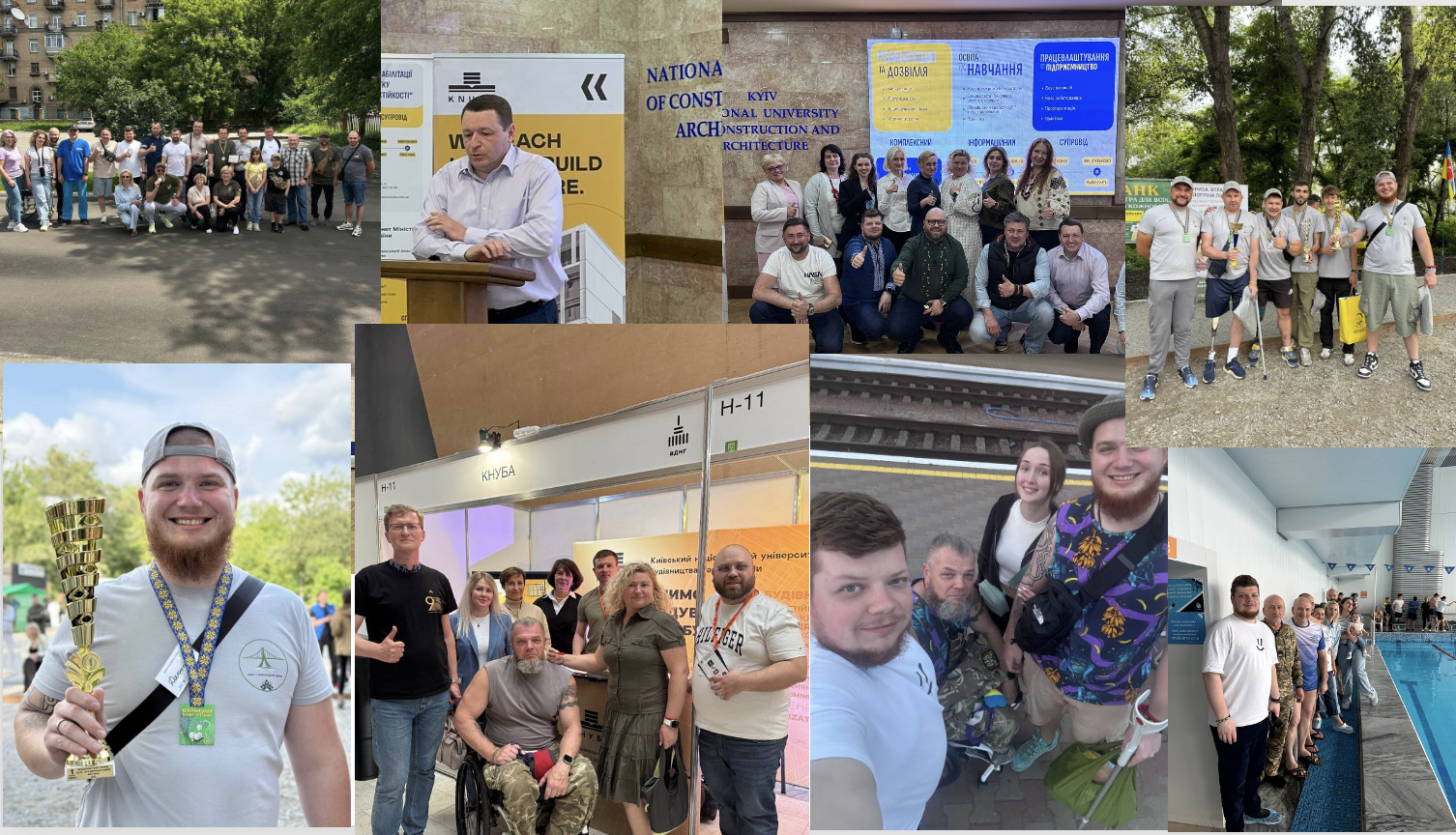
A special role in this process is played by the Veterans Institute “Architecture of Resilience” — an educational platform at the Kyiv National University of Construction and Architecture (KNUBA). A whole ecosystem of support for veterans, whose key element has become the Veterans Cluster of Ukraine. “We have built an ecosystem in which every element — education, professional development, rehabilitation and community — reinforces the others. The Veterans Cluster of Ukraine plays a key role in it, bringing veterans together with business, education, science and the public to create new opportunities,” — explains Artem Honcharenko, head of the KNUBA Veterans Institute. According to him, the mission of this initiative is to ensure a dignified future for veterans and their families, and help them realize their potential in peaceful life.
The Veterans Cluster and partner universities across Ukraine have already launched a number of programs that open the way to a new career for defenders. This ecosystem gives veterans and their families the following opportunities:
- Free education at the bachelor's or master's level, funded by the state or by partners (additional state-funded places have been allocated for veterans and their children).
- Retraining and professional development — short-term courses, a second degree, master's programs and even doctoral studies for those who aspire to academic growth.
- Psychological support and rehabilitation during studies — specialists help veterans cope with stress, work through trauma and adapt to the learning process.
- Practical participation in rebuilding the country — involving student veterans in real projects to restore infrastructure, in construction, demining of territories and so on, so that they gain invaluable work experience and apply the skills they have already acquired.
- Partner programs with employers — agreements have been signed with leading companies (for example, Google, Microsoft, Cisco and others) on employing veterans after they complete their studies.
- Flexible study formats — full-time, part-time and distance learning to choose from, which makes it possible to study without interrupting service, volunteering or work. Study centers operate both at leading universities in large cities and in communities and rehabilitation centers — that is, they cover the whole country, from front-line regions to those in the rear.
- Individual support for every veteran — mentors help from the moment of application until employment in the new field, sustain motivation and help overcome bureaucratic barriers.
“As long as distance learning remains available, it is a unique chance for our veterans and their families to get an education without interrupting service or work. We accompany everyone from the application stage to employment,” — stresses Artem Honcharenko, emphasizing that it is important to use all available opportunities right now. According to him, every student veteran not only gains a new profession for himself but also becomes a driving force of change in society. Yesterday's warriors bring their unique experience into the lecture halls — leadership, resilience to stress, the ability to work in a team. Younger students look up to them and adopt their patriotism and maturity of outlook. This is how the new elite of the nation – “an elite tempered on the battlefield and educated on the academic campus”.
Stories of a new life
Veterans themselves tell best about the transformations they are going through. Their stories are an inspiration for brothers-in-arms who are still hesitating over whether to sit down at a school desk. Here are a few such stories, each a vivid example of how education gives life its meaning back.
“After coming home I felt emptiness for a long time. It seemed that my mission was over and nobody needed me anymore. But when I enrolled at university, life lit up again with new colors — I felt needed, as if I had caught my second wind!” — says the veteran with the call sign “Titan”. His daughter studies alongside him, and this adds to his motivation. “We do our homework together and dream together about how we will rebuild our country. I no longer think about the past — I see the future,” — he adds.
“I see how studying has changed my husband. The spark has come back to his eyes, and he has a purpose. He feels needed, his shoulders have straightened — as if our family life had started anew”, — shares Olena, the wife of the veteran “Titan.” “Before, it was hard for him to find himself at home — he was used to his skills being needed at the front. And now I see that in civilian life too he can be a hero for his family. The children are proud of him, because their dad is both a veteran and a student!”
“I never thought that at 45 I would be taking exams again,” — smiles the female veteran whose call sign is “Phoenix”, a former volunteer medic. “But here I am, a master's student in psychology. After demobilization I was lost for a while: who am I now? A wife, a mother — yes. But where is my calling? When I learned about the program for veterans, I took the risk and enrolled. And I have not regretted it. It is as if I had rebooted myself. Instead of procrastination and memories — classes, books, new acquaintances. My brain is working at full capacity again, and most importantly, I know that tomorrow I will be needed. I want to help people like myself — veterans — to live through the trauma of war. Life has not ended; on the contrary, everything is starting anew!»
“At first it was frightening: 12 years in the army, and here — students, a campus, academic papers… I thought I wouldn't cope,” — recalls the veteran “Professor”, who got his call sign back at the front for his love of books. “But it turned out that we veterans can learn no worse than we can fight. From the very first days I felt support: the instructors help me catch up on the knowledge I need, and the younger classmates help with the computer and English. I am no longer a ‘former serviceman.’ I am a future civil engineer. I dream of designing bridges and roads to replace the ones the war has destroyed.” His wife Maryna notices one more change: “Before, my husband hardly ever talked about his service — he had withdrawn into himself. Now he shares news from the university every day. His eyes shine when he talks about a new project or a lab assignment. We both feel that this is a new stage of life. After so many years I see again the energetic young man I once married.”
These stories are only a few examples out of hundreds and thousands. Every veteran who has dared to sit down at a school desk has his or her own path and own motivation. But they are united by a common feeling: “we are needed, we are learning — therefore we are alive”. Education gives them not only a new profession but also restores lost dignity and faith in themselves. It also brings families together, because relatives see the positive changes and often join in the process. It is no accident that many educational programs are also open to family members of veterans, in particular their children. When a father and son receive their diplomas together, or a mother in military service and her schoolgirl daughter do their homework together — that is precisely the revival that Ukrainians dreamed of.
Building the future together
Ukraine is living through a turning point in its history. How the postwar reintegration of veterans goes will determine the face of our society for decades to come. Today the foundation is being laid not only for destroyed homes but also for a new economy, new communities and new opportunities for everyone. And veterans are a central part of this foundation. They paid a high price for our future and must now become co-creators of that future.
In the apt words of the ancient Roman philosopher Seneca, “every new beginning comes from the end of another beginning”. These words are especially close to Ukrainian veterans, whose “yesterday” was cut short by explosions and losses, while their “tomorrow” is being born right now, in persistent study and daily work on themselves. “Nobody can go back to the past and start everything over, but anyone can start today and create a new ending,” — Artem Honcharenko likes to repeat, urging veterans not to fear change. According to him, a second youth is real: “You have already done more for the country than anyone could demand. Now the country will do something for you — support you in your studies and open doors. Do not be afraid to start from scratch — you are not alone!”
The Ukrainian state and society are joining forces today so that every defender can feel that his experience at the front will not be in vain in peaceful life. The government has launched an education voucher program for veterans, who can receive partial or full financial compensation for their studies. Local authorities are opening veteran hubs, where one can get advice on enrolling or starting a business. Big business is launching internships and training for former military personnel. Volunteer organizations are finding opportunities abroad for the soldiers — from coding courses to entrepreneurship workshops.
But the greatest contribution is made by the veterans themselves — through their drive to learn and to grow. They set an example for each other and for the younger generation. That is why education has become a genuine driver of unity between generations: parents in the military and their children are now like-minded people, making shared plans together. Studying brings veterans' families closer, brings back the joy of communication and provides new topics of conversation instead of heavy memories of the war. Life has lit up with new colors not only for the defenders themselves but also for their loved ones, who see their smile and their sense of purpose.
It is time to act — the future is being made today. Every veteran who has decided to master a new specialty contributes not only to his or her own destiny but also to the destiny of the whole country. United around education, veterans and their children are creating a new success story for Ukraine. Join this community and support one another. Life after the war exists — and it can be big, bright and full of meaning. Start with education — right now. Your determination to study today changes our shared tomorrow.
Photo: Azov Brigade veteran Oleksandr Zhavnenko dances with his wife Maria for the first time after receiving a prosthesis — a symbol of how veterans' lives take on new colors in peaceful life (Lviv, June 2025).
