Experts named the skills that will ensure a specialist’s competitiveness in the age of artificial intelligence
The use of artificial intelligence has already become an everyday practice for most students and employees, but the key competitive advantage in the labor market in the coming years will remain not technical but human skills – communication, leadership, emotional intelligence, critical thinking and the ability to work with people. This is the conclusion reached by participants in the press conference on the topic “Higher education and MBA education in the era
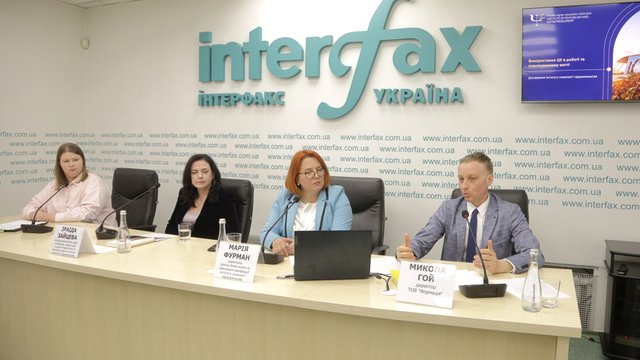
The use of artificial intelligence has already become an everyday practice for most students and employees, but the key competitive advantage in the labor market in the coming years will remain not technical but human skills – communication, leadership, emotional intelligence, critical thinking and the ability to work with people. This is the conclusion reached by participants in press conference on the topic “Higher education and MBA education in the era of artificial intelligence. Which professions and skills will remain with humans?”, held at the “Interfax-Ukraine” agency on Wednesday.
As Mariia Furman, director of the Center for Business Education and Professional Development at the Institute of Psychology and Entrepreneurship, reported, the study, conducted on the basis of cooperation between students and business, covered more than 250 respondents from the fields of law, HR, IT, consulting, marketing, management, foreign economic activity, education, sales and finance.
“At present, more than 97% of respondents already use artificial intelligence at work or in everyday life, and more than 50% turn to it at least once a day. The most common tools turned out to be ChatGPT, Google Gemini, Claude and Copilot, and the main use cases were explaining complex information, writing and editing texts, generating ideas, translation, data analysis and preparing summaries,” she said during the presentation of the study “The use of AI at work and in everyday life.”

At the same time, according to Furman, the spread of AI does not automatically mean growing trust in its answers. She pointed out that about 30% of daily functions are already being replaced by such tools, yet the largest share of respondents rated their level of trust in AI answers as medium – information can be trusted only if it is verified. More than 50% of respondents always verify generated answers, another 33% do so if the information looks suspicious, and 13% when it comes to particularly important work. In addition, more than 30% of respondents very often encountered distortion of information, and another 53.6% reported that such cases had happened to them several times.
“According to World Economic Forum estimates, by 2030 more than 40% of skills worldwide will change, which means a need for rapid retraining of both current employees and students. She emphasized that higher education must not merely familiarize young people with digital tools, but restructure its approaches to teaching so as to prepare specialists capable of working together with AI rather than mechanically relying on it,” the expert stressed.
According to her, artificial intelligence has already become part of education and business, but its effect lies not in fully replacing humans but in transforming their functions.
“That is why analytical thinking, communication, adaptability, people management, emotional intelligence and creativity are of particular value today,” Furman stressed.
She added that AI will not be able to displace managers, psychologists, HR specialists, communications managers, teachers, mentors, or those responsible for strategy and team development, because in these professions human trust, leadership, empathy and the ability to work with context remain decisive.
For her part, Iraida Zaitseva, Doctor of Economic Sciences, professor and vice-rector for research, teaching and academic affairs at the Institute of Psychology and Entrepreneurship, emphasized that even the most powerful algorithms cannot replace a manager, because they lack consciousness, creativity and moral reflection. She recalled that a machine may advise cutting staff for the sake of higher profit, but is unable to assess the social, ethical and even geopolitical consequences of such a decision.

“Artificial intelligence is a powerful engine, but only a human should be the pilot who knows where and why they are flying. We teach students not merely to use a tool, but to validate decisions, to treat the algorithm’s “black box” critically and to bear personal responsibility for the result. At the institute, AI may be used as an auxiliary tool for structuring material or searching for ideas, but the student is obliged to state that it was used, verify the sources and answer for the content of the work; otherwise this may be treated as academic dishonesty,” Zaitseva noted.
Wesley Lacerda, CEO of Capolavoro Group (Brazil), lecturer at the Brazilian institute AMF and investor in technology startups, focused on the risks of improper use of artificial intelligence in business. In his assessment, the main danger lies not only in the technology as such, but in the gradual cognitive weakening of the person, when the user gets used to handing over to the machine his own memory, analytical abilities, speech and even the elementary ability to make decisions independently. In his presentation he separately named cognitive deterioration, a decline in intelligence, a weakened capacity for reflection and the loss of social skills as the main risks of the widespread adoption of AI.

“Artificial intelligence should be used as a tool for data analytics, not as a replacement for human thinking. When a person stops understanding what is behind the machine’s answer, he loses his own cognitive abilities, and with them the ability to make independent decisions,” Lacerda noted during his talk.
He also drew attention to the fact that the new wave of automation creates demand primarily for AI analysts, AI engineers, AI Ops specialists and algorithmic audit specialists, and not only, and not so much, for IT specialists as such. Yet even in these roles, what remains decisive is the human understanding of what is being done and why, not merely the ability to write the right prompt for the machine.
For her part, Sofiia Vorushko, a recruiter at 3S Agency, stressed that in hiring, artificial intelligence creates an illusion of objectivity but still cannot replace a live recruiter. According to her, candidates are increasingly preparing for interviews with the help of AI, using the right wording and socially desirable answers, yet the algorithm is unable to fully read nonverbal signals, understand a person’s motivation, their real experience and their fit with the culture of a particular company. She gave the example of two vacancies for an executive assistant that looked identical at first glance but in practice required completely different candidates because of the differing management styles of the executives.

“Today the market increasingly evaluates an employee not only by hard skills and more and more by soft skills. Communication, resilience, flexibility, adaptability, leadership and the ability to build relationships are becoming critically important because they are the hardest to automate,” Vorushko added.
She cited global estimates according to which 63% of employers name a shortage of soft skills as a barrier to business development, 67% of companies are looking for flexibility and adaptability, 61% for leadership and social influence, and demand for social and emotional skills will grow by a further 24% by 2030. According to the recruiter, 75% of an employee’s long-term success currently depends on soft skills, whereas hard skills account for only about 20%.
At the same time, Mykola Hoi, director of “Formatsiia” LLC, noted that for a business built on communication with clients, partners, dealers, manufacturers and suppliers, the direct transfer of decisions to AI is extremely limited. According to him, in his company, which works in the solar energy sector, about 95% of working time is precisely work with people, and therefore template-based algorithms cannot fully replace live contact in sales, in team selection or in developing marketing solutions.

“Artificial intelligence can be used in business, but only if its limits are understood very clearly. Founding a business, selecting a team, marketing, sales, working with the client and making quick decisions in a changing environment remain the human’s area of responsibility, because what is needed here is not templates but knowledge, experience and understanding of another person,” Hoi stressed.
He added that the use of AI in HR processes can lead to mistakes if a company tries to assess candidates only by formal criteria, without giving the person the chance to reveal his or her potential in live communication.
The participants also noted separately that the Institute of Psychology and Entrepreneurship is betting on the specialties that, in the organizers’ view, are least susceptible to automation: personnel management, communication management and psychology. The institution reported that tuition for the bachelor’s program is UAH 42,000 per year and at the college UAH 28,000 per year; cooperation with partners in the Baltic states, as well as in Poland, the UAE and Brazil, where students can do internships, was also announced. Thanks to an ontological approach that helps develop the personality and to the combination of psychology with up-to-date knowledge from business practitioners, the institute’s students comprehensively develop personal and professional skills. This helps them become top-level managers and not be dependent on technology. This level of training allows students, starting from the second year, to work on business projects in their professional field.
Summing up the discussion, the experts agreed that Ukrainian higher education and MBA programs can no longer ignore artificial intelligence, but nor should they make it an end in itself. The issue is not a struggle of humans against machines, but a new distribution of roles, in which AI takes on routine, analytical and technical functions, while strategy, ethics, creativity, empathy, team management and responsibility for decisions remain with humans. It is these qualities, in the opinion of the event’s participants, that will determine a specialist’s competitiveness over the next 5-10 years.