Architecture of Resilience: how education helps veterans build a new life
This institute is a structural unit of the university, created during the full-scale war to facilitate the integration of veterans, service members and their families into civilian life by providing educational, rehabilitation and career opportunities. Since its creation, the veterans institute has been helping defenders and their children become students and find a new path through education. At a time when Ukraine has an unprecedented number of veterans,
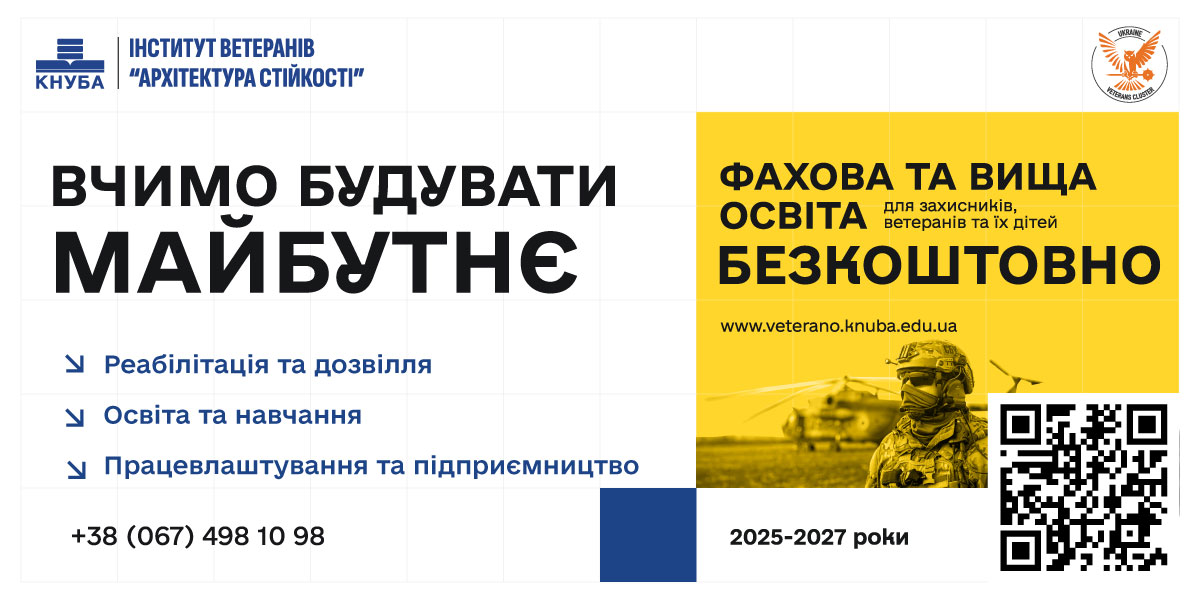
This institute is a structural unit of the university, created during the full-scale war to facilitate the integration of veterans, service members and their families into civilian life by providing educational, rehabilitation and career opportunities. Since its creation, the veterans institute has been helping defenders and their children become students and find a new path through education.

At a time when Ukraine has an unprecedented number of veterans, education for them is becoming no less important than medical rehabilitation. For many soldiers, learning a new trade means not only a chance of employment but also psychological therapy, a new meaning in life and a way to continue serving the country in the civilian sphere. To find out how these ideas are put into practice, we spoke with Artem Honcharenko, head of the Institute of Veterans “Architecture of Resilience” (ed.: Artem is Vadym's son), about the achievements and plans of this project.
Interview with Artem Honcharenko
Correspondent: What results has the veterans institute achieved since it began its work?
Artem Honcharenko: Our institute began as a bold idea, and now it is a real community of like-minded people and also of student veterans. We have created a database of veterans and their families who want to study – it already contains several hundred names. We help each person draw up an individual “road map”: from choosing a specialty to preparing documents. Veterans are accompanied by tutors, psychologists and lawyers. We have set up “routing” – we direct each person, when needed, to rehabilitation centers, employment centers or other services.
Thousands of fighters have already used our help, and several hundred of our students have been successfully employed in their new profession. We pay great attention to the psychological support and physical rehabilitation of veterans during their studies, so that education becomes a comfortable and healing process for them.
Correspondent: What educational opportunities does KNUBA currently offer to veterans?
Artem Honcharenko: The choice is very wide. Kyiv National University of Construction and Architecture currently offers veterans more than 100 different educational programs – from technical and creative to managerial ones. Many people are surprised, but at KNUBA you can study not only architecture or construction engineering. Our veterans are mastering IT specialties, computer design, ecology, management, marketing – everything they like.
In fact, the university has programs ranging from IT, SMM and marketing to cost estimating, architecture and even training specialists in property valuation. That is why every veteran here can find their own path – regardless of previous experience and taking their health into account.
Correspondent: Your father is one of the future student veterans. Tell us how he decided to study and what he wants to achieve.
Artem Honcharenko: My dad's name is Vadym Honcharenko, and his combat call sign is Kinolog. After a severe injury he moves around in a wheelchair. But despite that, he did not break. And you know, when I suggested that he enroll at the university, at first he took it with skepticism, saying, what would I do there among young people?
But together we chose a specialty for him – sport. He always dreamed of working professionally as a coach, and now this dream is finally coming true. Right now my dad is preparing to enroll in the Faculty of Geoinformation Systems and Land Management at KNUBA. He attends university courses for veterans and consultations, talks with the lecturers, picks his routes and learns to work with computer programs. You should see how his eyes light up! My father says he feels needed again. And besides that, he trains, supports other veterans, wins competitions and, most importantly, brings his brothers-in-arms together around him and creates a space for support and development.
State support and international experience

Government support for educational initiatives for veterans and their families has recently been expanding. In March 2025 the Cabinet of Ministers of Ukraine adopted an experimental project that effectively provides free education at colleges and universities for the children of defenders. This is a one-time targeted financial assistance from the state, which will be paid in 2024–2026 to children of certain categories – that is, to those who study on a fee-paying basis. The following will be able to use this program:
- children of fallen defenders;
- children who became persons with disabilities as a result of the war;
- children of combatants (UBD status holders);
- children of persons missing under special circumstances;
- children who were held in captivity;
- as well as children whose parents were harmed during the Revolution of Dignity.
In general, the following categories by social status and benefits have the opportunity to study free of charge:
- Persons with disabilities as a result of the war.
2. Persons affected by the Chornobyl disaster:
– first and second category
– children with disabilities under 18 – in connection with the Chornobyl disaster
– children of deceased persons from among:
– participants in the liquidation of the consequences of the accident at the Chornobyl nuclear power plant (assigned to category 1, 2), whose death is related to the Chornobyl disaster
– from among the participants in the liquidation of the consequences of the Chornobyl NPP accident assigned to category 3, whose death is related to the Chornobyl disaster
– children of those affected by the Chornobyl disaster (assigned to category 1).
3. Persons with disabilities.
4. Persons recognized as injured participants of the Revolution of Dignity.
5. Participants in combat operations (UBD status holders).
6. Orphans, children deprived of parental care, and persons from among them:
– an orphan child whose parents have died or been killed
– children deprived of parental care due to the deprivation of the parents' parental rights
– children deprived of parental care due to being taken away from their parents without the deprivation of parental rights
– children deprived of parental care because the parents were declared missing or legally incapacitated, or declared dead
– children deprived of parental care because the parents are serving a sentence in places of detention or are in custody during the investigation
– children deprived of parental care because the parents are being sought by the internal affairs authorities in connection with evasion of alimony payments and there is no information about their whereabouts
– children deprived of parental care because of a long-term illness of the parents that prevents them from fulfilling their parental duties
– children separated from their family, foundlings whose parents are unknown; children abandoned by their parents; children whose parents do not fulfill their parental duties for reasons that cannot be established because the parents are in the temporarily occupied territory of Ukraine or in the zone of the anti-terrorist operation, and homeless children
– persons aged 18 to 23 whose parents died or were killed before they turned 18, and persons who were classified as children deprived of parental care.
7. Children with disabilities.
8. Persons whose place of residence is registered (declared) in the temporarily occupied territory or in settlements classified as territory of possible combat operations as of July 1, 2025.
9. Persons one of whose parents (adoptive parents) was a police officer who was killed or declared missing by a court in the performance of his or her official duties, within three years after obtaining the corresponding general secondary education.
10. Children of killed (deceased) persons defined in part one of Article 10¹ of the Law of Ukraine “On the Status of War Veterans, Guarantees of Their Social Protection”, and persons from among them.
11. Persons one of whose parents is a participant in combat operations on the territory of other states who was killed (went missing) or died as a result of a wound, contusion or injury received during military operations and conflicts on the territory of other states, as well as as a result of an illness connected with staying on the territory of other states during those operations and conflicts.
12. Persons one of whose parents (adoptive parents) was a service member who was killed or declared missing by a court in the performance of military service duties.
13. Persons who are internally displaced persons in accordance with the Law of Ukraine “On Ensuring the Rights and Freedoms of Internally Displaced Persons”.
14. Persons for whom the fact of deprivation of personal liberty as a result of armed aggression against Ukraine has been established.
15. Children from large families (five or more children).

In addition, the state is introducing educational grants for the veterans themselves. In particular, a government initiative provides for the possibility for fighters to receive funding for master's studies in certain specialties. Such steps show an understanding that an investment in the education of veterans is an investment in the economy and security of the country.
A comprehensive approach is complemented by the efforts of the educational institutions themselves. The Institute of Veterans “Architecture of Resilience” is not limited to the purely educational process. We look after every veteran from admission to graduation. The institute's specialists help adapt the schedule and study load to veterans' capabilities, track their progress, and provide mentoring and legal support. Together with partners, the institute organizes sports training, competitions and leisure activities for veterans at the university sports complex – this is part of their rehabilitation. Integration with business is also an important direction. For example, in autumn 2024 the institute arranged a meeting of student veterans with employers, where they discussed funding for studies, professional development, the creation of inclusive jobs, rehabilitation programs and entrepreneurship. Representatives of Ukrainian companies and international organizations joined the discussion, including the Veterans Cluster of Ukraine, the International Technology Transfer Association (ITTA) and the industrial enterprise Axor Industry. The result was new employment opportunities for students and ideas for future courses and internships.
Global experience confirms that education can be a powerful engine for the reintegration of veterans into peaceful life. After World War II the program G.I. Bill (official name – the Servicemen's Readjustment Act of 1944), which gave veterans the opportunity to receive a higher or vocational education free of charge. By 1956 it had been used by 7.8 million American veterans: 2.2 million graduated from colleges or universities, and another 5.6 million completed vocational courses. Historians and economists regard the G.I. Bill as an extremely successful socio-economic project: the country gained a whole generation of educated specialists, and the veterans gained a dignified way to fulfill themselves. Similar programs were introduced by US allies as well – for example, Canada gave its World War II veterans comparable educational opportunities, with an equally positive effect.
The experience of modern conflicts also shows the importance of education for veterans. In many NATO countries there are retraining programs for service members: from IT and cybersecurity courses to small business support. In Israel, where almost every citizen serves in the army, “from soldier to student” initiatives work successfully, helping former military personnel obtain civilian professions. All these approaches reduce the risk of isolation of veterans and allow society to gain motivated, responsible specialists in various fields.
Conclusion
University lecture halls and dormitories are becoming the place today where the resilience of postwar Ukraine is being forged. Educated veterans are a new elite who strengthen the country in various fields with their experience and patriotism. Initiatives like the “Architecture of Resilience” institute are important because they give our defenders and their children not only knowledge but also faith in the future. By investing in the education of veterans today, Ukraine is laying the foundation of its revival.
Contacts of the Institute of Veterans for admission:
https://veterano.knuba.edu.ua/reiestratsiyni-formy/
+38 073 94 96 179
+38 050 22 35 182
+38 067 49 81 098

