“Avto-Rehion” intends to increase the share of the Turkish brand Temsa on Ukraine's bus market to 10% in 2024 thanks to school buses
The company “Avto-Rehion”, the exclusive distributor of Temsa buses from Turkey in Ukraine, plans to sell about 100 buses of this brand in 2024, which will raise its market share to 10% from 2% in 2023, when 20 buses were sold, said Mykyta Haidamakha, head of the bus production division. “Last year our share was 2%, but it was the start of joint…
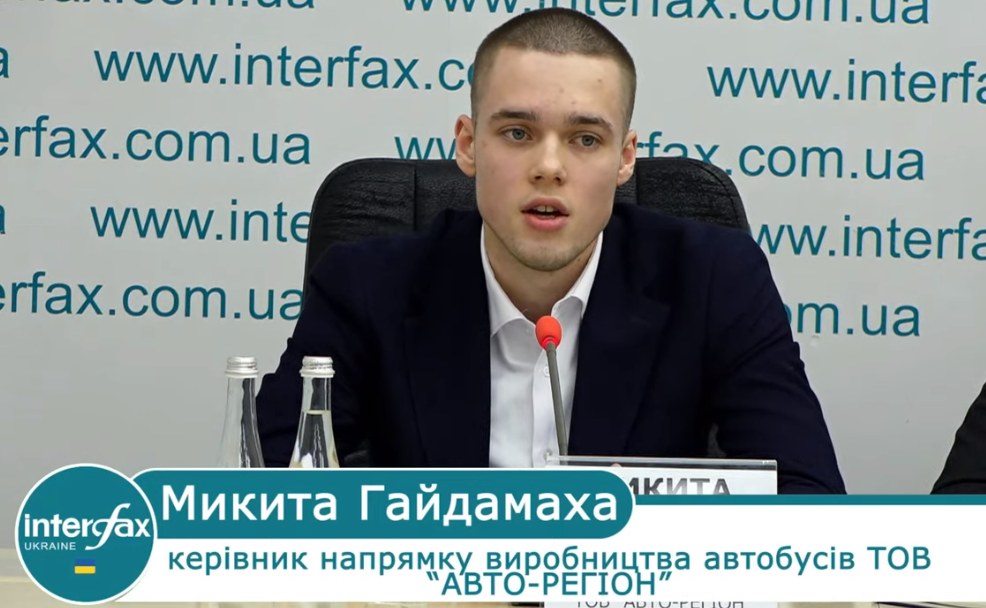
The company “Avto-Rehion”, the exclusive distributor of Temsa buses from Turkey in Ukraine, plans to sell about 100 buses of this brand in 2024, which will raise its market share to 10% from 2% in 2023, when 20 buses were sold, said Mykyta Haidamakha, head of the bus production division.
“Last year our share was 2%, but it was the start of joint bus production with Temsa in Ukraine, and this year we plan to sell at least 100 buses, primarily through participation in the state program “School Bus”,” he said at a press conference at the Interfax-Ukraine agency on Wednesday.
Haidamakha clarified that the company has so far managed to reach a localization level of almost 20% and is currently working to raise this share to 25% this year, taking into account the requirements of the localization law.
According to him, two models are currently localized in Ukraine: the Prestij SX intercity bus with 30 seats and a school bus based on this model.
“Today the first production batches of these models are at the final stage of manufacturing and will be available to order from April,” Haidamakha specified.
He added that large contracts with Ukrainian component manufacturers have already been signed to implement the production program.
As the company's head of sales Oleksandr Butenko specified, the Ukrainian components in the bus include seats, double-glazed windows, autonomous heating systems and interior fittings.

“Negotiations are currently under way with a Ukrainian company on installing the Smart Bus system, which is both an alert system that can locate the nearest shelters and even lets parents see their children on the bus,” Butenko specified.
Haidamakha, for his part, stressed that the company is currently developing a large investment project and plans to defend it with the aim of starting production in Ukraine of all buses in the Temsa model range.
“In particular, yesterday we received the first updated model of a 55-seat tourist bus, we are bringing in engineers to study the product, and we will look for ways to localize it here,” he said.
In addition, the possibility of creating a school bus with an electric motor is being considered, with the project planned for implementation in the near future.
According to him, the Temsa school bus is significantly more expensive than models from domestic manufacturers; it costs 4 million 950 thousand hryvnias.
“But we do not set ourselves the task of competing on price. The main goal we have set together with our partners is not so much to develop production as to bring the experience and standards that apply around the world to Ukraine. We want to show by our own example that such transport is more expedient and to change the existing market in Ukraine,” Haidamakha stressed.
He expressed the opinion that, when shaping a national transport strategy, Ukraine needs to understand how far cost-cutting and certain savings in procurement will later turn into overpayment in the future, when it becomes necessary to replace vehicles with ones that meet European standards.
Haidamakha drew attention to the fact that many tenders in Ukraine for the supply of electric buses funded by European financial institutions currently receive no bids and are postponed because manufacturers cannot meet the customer's conditions.
In addition, in his opinion, a “bottleneck” in the localization law is the inability to meet the existing demand in Ukraine for supplying tourist buses to state bodies.
“Given the closed airspace in Ukraine, we often receive requests from state bodies for tourist buses with 55 or more seats to transport employees abroad, but such vehicles are not mass-produced in Ukraine, and such production requires large investment, experience and a technological base. It is hard to localize, and as a result we are forced to turn such clients down,” Haidamakha said.
The company's head of marketing Khrystyna Bratchykova, for her part, noted that Temsa buses already took 11% of the market in January (according to Ukravtoprom), with 13 buses registered.

“Temsa's share testifies to consumer trust and to the fact that business is looking toward transport that meets the ‘Euro 6’ eco-standards. At present the bus market is concentrated around school buses, but overall demand for buses exceeds supply, and we have requests for large tourist buses and even for electric transport. So we believe the market will grow this year,” she noted.
For his part, Hakan Koralp, Temsa's vice president for sales and marketing, noted that the company sees great prospects in the Ukrainian market and pays great attention to it.

“We started negotiations with ‘Avto-Rehion’ in 2021 and signed a representation agreement in 2023. We are actively studying the requirements of the localization law, and we are glad that ‘Avto-Rehion’ has received Temsa's permission to carry out finishing work on incomplete vehicles, such as the Prestij SX, in Ukraine, and we are confident that this is only the beginning,” he noted.
Hakan Koralp remarked that Temsa currently has a wide model range of city and tourist buses from 7 to 14 meters long, holds a significant share of the US bus market and has more than 10,000 buses operating on the European market.
The company's deputy director Vitalii Pasichnyi recalled that, besides Temsa bus equipment, “Avto-Rehion” officially represents in Ukraine the Korean brand of trucks and special vehicles Daewoo Trucks and the Indian carmaker TATA.

“This year we plan to expand the model range of these brands, and if in 2023 65 Tata Xenon cargo pickups were delivered to Ukraine, about 350 are planned this year. In addition, we plan to sell about 300 Daewoo Trucks, and more if there are orders. We have already brought in a medium-tonnage Daewoo with a gross weight of 10 tons, and by the end of the year something will appear at TATA as well,” he noted.
Pasichnyi noted that cooperation with Daewoo began in 2020. They supplied municipal, commercial and fire vehicles. To date, according to him, more than 200 projects have been implemented, and more than 2.5 thousand vehicles of this brand are already running in Ukraine.
He named the price-quality ratio and the most affordable price for pickups on the Ukrainian market as the main advantages of TATA pickups. Pasichnyi also specified that production of pickups in Ukraine is not planned.
The head of the technical department of “Avto-Rehion” Viktor Kovbyk, for his part, said that the company has a service network in Ukraine and plans to sign up to 20 service agreements.

“We could do more, but the obstacle is martial law and a number of other factors,” he said.
At the same time, Kovbyk noted that the partners did not stop cooperation when the full-scale war began. “And already in April 2022 they resumed our orders and began implementing projects even without prepayment, which speaks of trust in us,” he stressed.
According to him, the company's spare parts warehouse for three brands, with an area of more than 1,000 sq m, makes it possible to ensure three months of uninterrupted operation without additional deliveries.
In addition, the company has three mobile crews for work in remote areas and also repairs vehicles for Ukrainian service members free of charge at service stations.
Speaking about the company's problem in connection with mobilization, Pasichnyi noted that “Avto-Rehion” is currently submitting documents to be included in the list of critical infrastructure enterprises so that employees can be reserved from mobilization, since the company services vehicles for municipal services and the military and has contracts with the military.
At the same time, he added that last year “Avto-Rehion” managed to increase its headcount by 30%, primarily by attracting young specialists.
Answering a question from the agency “Interfax-Ukraine”, Pasichnyi noted that in 2022-2023 public procurement accounted for 90% of the company's sales, because business is not yet ready to invest money and “for the most part buys cheap or old”.
It was also noted that the company does not undertake to make long-term forecasts for the car market in Ukraine because of the war.
“There is pent-up demand for cars, and a forecast is complicated for now because of the war, but after victory we predict a significant leap and hope that Ukraine will repeat the results of the car market of 2006-2007,” Kovbyk summed up.
LLC “Avto-Rehion”, with an authorized capital of UAH 230 thousand, was registered in 2004 in Kyiv. It specializes in supplying special vehicles, trucks and buses for urban, intercity and tourist transport. It has 10 official service centers in Ukraine.
The owner of 100% of the company is Dmytro Haidamakha, who, according to the participants of the press conference, is currently serving in the armed forces of Ukraine.
According to the Clarity system, in January-September 2023 the company increased its net profit 11.6-fold compared with the same period of 2022, to UAH 75.3 million, with net revenue growing 3.2-fold to UAH 1 billion 234 million.
In 2022 the company's net revenue grew 3.8-fold compared with 2021, to UAH 656.2 million, and net profit was UAH 41.3 million, compared with UAH 0.88 million.