The economy and taxes are the means to continue Ukraine's fight and build a successful future
On March 25, 2024, the Congress “Reform of State Finances – the Path to the Recovery of Ukraine,” organized by leading business associations and think tanks with the support of CIPE, took place in Kyiv. Government officials, members of parliament, experts and business representatives took part in the Congress. Among the representatives of the authorities present were the head of the “Servant of the People” party, the chair of the Verkhovna Rada of Ukraine committee on the organization of state power, local self-government…
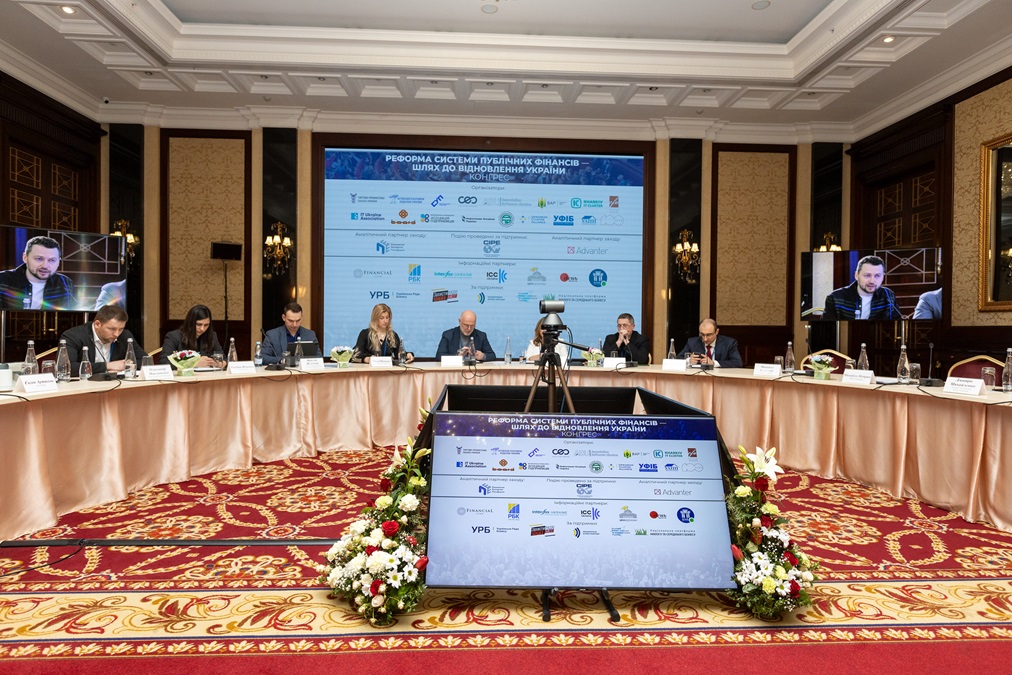
On March 25, 2024, the Congress “Reform of State Finances – the Path to the Recovery of Ukraine,” organized by leading business associations and think tanks with the support of CIPE, took place in Kyiv.
Government officials, members of parliament, experts and business representatives took part in the Congress. Among the representatives of the authorities present were the head of the “Servant of the People” party, the chair of the Verkhovna Rada of Ukraine committee on the organization of state power, local self-government, regional development and urban planning Olena Shuliak; chair of the Verkhovna Rada of Ukraine committee on economic development Dmytro Natalukha; first deputy chair of the Verkhovna Rada of Ukraine committee on finance, tax and customs policy Yaroslav Zhelezniak; chair of the Verkhovna Rada of Ukraine committee on social policy and protection of veterans’ rights Halyna Tretiakova; deputy chair of the committee on finance, tax and customs policy Olha Vasylevska-Smahliuk; chair of the Verkhovna Rada temporary investigative commission on the protection of investors’ rights, chair of the parliamentary special commission for the Protection of Investors Halyna Yanchenko; head of the Asset Recovery and Management Agency Olena Duma, Deputy Minister of Economy of Ukraine Oleksii Sobolev and others.
Business was represented by the first vice president of the Chamber of Commerce and Industry Mykhailo Nepran, president of the All-Ukrainian Professional Association of Entrepreneurs, member of the supervisory board of the “ZakhystyFOP Council of Cities” Borys Emeldesh, executive director of the IT Ukraine Association Mariia Shevchuk; executive director of the Union of Ukrainian Entrepreneurs Kateryna Hlazkova, executive director of Kharkiv IT Cluster Olha Shapoval and many other heads of leading associations, from the think tanks, the executive director of CASE Ukraine took part Dmytro Boiarchuk, head of Advanter Group Andrii Dlihach; coordinator of the expert groups of the Economic Expert Platform Oleh Hetman, chair of the council of the Institute of Tax Reforms Olena Khotenko and others.
During the Congress, representatives of economic think tanks and leading business associations presented a shared vision of the reform of the state finance system of Ukraine, which Ukraine needs at the stage of recovery and on the path to European integration. The discussion concerned, first of all, tax and budget reform, changes in mobilization processes, and the reform of law enforcement agencies. Participants of the Congress stressed that these steps need to be implemented right now.
The chair of the Verkhovna Rada of Ukraine committee on the organization of state power, local self-government, regional development and urban planning Olena Shuliak noted that the recovery of Ukraine is a process that can be perceived only as the physical restoration of this or that facility. But this is not so at all. Recovery is divided into two large categories:
- planning of reconstruction taking into account environmental, demographic and economic challenges;
- carrying out systemic reforms aimed not only at reconstruction itself but also at changing the political and legal reality, taking into account the development of state institutions and the economy of Ukraine.
Without business and the economy, it is impossible to speak of sustainable and long-term recovery of Ukraine as a whole, as well as of individual communities. At the same time, the problems remain common, regardless of whether it is a frontline area or a nominally rear one: a high level of corruption; the shadow economy; tax evasion; a low level of economic freedoms; pressure on business from regulatory bodies, and so on.
“Business and the authorities understand that the economy and taxes are the ability to continue our state’s struggle and to build a successful future for Ukraine. That is why it is necessary to solve long-standing and systemic problems that hold business back. It is a matter of the survival and development of our state.” – noted Olena Shuliak.
The deputy chair of the Verkhovna Rada committee on finance, tax and customs policy Olha Vasylevska-Smahliuk noted that the “Investment Nannies” had not lived up to the hopes placed on them. According to her, systemic reforms are needed. “Manual control of the tax service and customs does not lead to good results, but only to selective justice and selective unblocking for a certain percentage through an intermediary,” she said.
The chair of the parliamentary committee on economic development Dmytro Natalukha said that economic reservation from mobilization would bring the budget more than 200 billion UAH a year. “At present the committee’s activity is focused on meeting the budget’s financing needs through various instruments. The first is direct fiscal provision for defense spending. And here we rely not on a mass increase in taxes, but on creating new mechanisms, on searching for new instruments and new ways. And among other things, we are not ruling out the issue of economic reservation, which, according to our calculations, can bring in from 200 billion UAH a year,” he said Dmytro Natalukha, chair of the parliamentary committee on economic development. This refers to an additional payment of the military levy in that amount.
An alternative option is being prepared in the Cabinet of Ministers – reservation of workers who officially earn more than 35,000 UAH. “Work on the reservation system is under way. I hope the system will start working soon,” noted the Deputy Minister of Economy Oleksii Sobolev.
Also Dmytro Natalukha said that the committee on economic policy, together with representatives of the business community, is developing a number of draft laws that will simplify the work of small and medium-sized businesses.
“We are aiming for real documents to appear in the legislative field in the next few months, reflecting what we have worked out together with business,” he noted.
The chair of the Verkhovna Rada of Ukraine committee on social policy and protection of veterans’ rights Halyna Tretiakova noted that business representatives pay a lot of attention to ideas for reducing taxes and cutting tax revenues, but pay almost no attention to social projects that can significantly reduce budget expenditures and free up resources for other areas. A dozen such projects have been developed and registered in the Verkhovna Rada, concerning trade union property, optimization of social fund expenditures and the like.
A significant problem is also the imbalance between the salaries of members of parliament and the staff of the Verkhovna Rada: differences in the amounts of several times demotivate the people’s elected representatives.
“Rebooting the BEB and customs in 2025 will be too late,” stressed Yaroslav Zhelezniak.
“There is no better year to build and rebuild trust in the institutions directly involved in interaction with business than 2024. In 2025 it will already be too late.”
“That is why this year we must carry out a reboot of customs. And this year we must carry out a full-fledged reboot of the BEB with full re-attestation of all personnel after the director is chosen,” noted Yaroslav Zhelezniak.
The head of Advanter Group Andrii Dlihach noted that the mobilization of 25% of employees could lead to the loss of more than half of the turnover of Ukrainian business. According to the results of the survey of business representatives presented by Andrii Dlihach, two thirds of respondents supported economic reservation of employees with salaries from 30,000 UAH. “Most believe that economic reservation is a rational, correct step that will make it possible to bring salaries out of the shadows and increase budget revenues,” he said.
“Because of the lack of systemic reservation of IT industry specialists and of a transparent mechanism for business trips abroad, the Ukrainian economy loses every month foreign currency revenue equivalent to almost 2 billion UAH due to contracts that the IT business fails to conclude. This negatively affects tax revenues, jobs and the position of Ukraine’s IT industry in the world,” noted Olha Shapoval, executive director of Kharkiv IT Cluster.
The issue of interaction between business and law enforcement also requires an immediate solution. “It is critically important for us to reduce the pressure on business. All of us must get involved in changes to legislation. There are two things we are working on with the business community. The first is the standards of conduct for prosecutors. We, as SUP, proposed this idea back in 2020. Standards of conduct for prosecutors were developed, which were approved and had a recommendatory character. Experience has shown that a recommendatory character does not work for us, and this must be mandatory,” said the executive director of the Union of Ukrainian Entrepreneurs Kateryna Hlazkova.
The deputies agreed that this area needs immediate changes. “Since the beginning of 2023, the interaction between business and law enforcement has not always satisfied business. There are systemic problems that need to be regulated at the legislative level. We have drafted bill No. 9211 with amendments to the Criminal Procedure Code. And it concerns not only the BEB, but all law enforcement agencies,” said the chair of the parliamentary temporary investigative commission on investor protection Halyna Yanchenko.
The issue of total fiscalization also proved painful. “Business has to lose UAH 35 billion on cash registers and inventory accounting so that the state budget receives UAH 8 billion. According to the economic calculations of think tanks, broad fiscalization of all of Group 2 and all of Group 3 of simplified-tax-system entities is socially negative regulation,” said the president of the All-Ukrainian Professional Association of Entrepreneurs Borys Emeldesh.
Mykhailo Nepran, the first vice president of the Chamber of Commerce and Industry, noted that, given business's constant problems with law enforcement, it is advisable to carry out a legalization of property. “A period has come when the first millions exist in Ukraine and they need to be legalized. This should be not merely a recognition of property rights but also their legalization. The Prosecutor General supports this idea. We need to adopt an appropriate legislative act that would recognize existing property, and no law enforcement agency should touch it any more,” proposed the first vice president of the Chamber of Commerce and Industry.
Following the Congress, there will be approved Congress Resolution “Public Finance System Reform – the Path to Ukraine's Recovery,” which will be signed by all the country's leading business associations.
The main points of the Resolution are:
- Key institutional reforms, minimizing corruption (a reset of the Economic Security Bureau, the State Customs Service of Ukraine, and the State Tax Service of Ukraine).
- Introducing an inclusive approach to the formation of state policies and strategies, in particular, providing that all subjects of legislative initiative must submit a regulatory impact analysis (ARV) and that a certain minimum number of deputy-authors is required to register a draft law.
- Recovery and development of the economy, preservation of economic potential: introducing an optimal model of economic reservation, e-reservation and e-business trips.
- Preventing pressure from law enforcement agencies on business, which leads to significant economic losses: establishing the principle of the presumption of innocence of the taxpayer, concentrating the functions of pre-trial investigation of economic crimes exclusively in the BEB, amending the Criminal Procedure Code.
- Reform of the tax system and customs legislation: reducing the overall tax burden on the payroll fund, replacing the discretionary corporate profit tax with a tax on withdrawn capital after the end of martial law, changing the philosophy of SMKOR from “punitive” to analytical, introducing a maximum period for blocking tax invoices, ensuring the preservation of the current simplified tax system, and moving from broad fiscalization to risk-oriented fiscalization.
- Preserving the immutability of the guaranteed commitments regarding the terms of doing business under the Diia City tax regime.
- Introducing a system of support and incentives for entrepreneurship in territories of possible hostilities and in de-occupied communities.
- Reducing inefficient state budget expenditures: adapting the volume of state spending to the new demographic realities, reducing spending on representative bodies of state power, the justice system, education, healthcare and housing subsidies.

