The leadership of Derzhliksluzhba is squeezing the laboratory of the Marzieiev Institute out of the medicines quality control market – laboratory head
Kyiv. July 20. INTERFAX-UKRAINE – The leadership of Derzhliksluzhba (the State Medicines Service) is squeezing the laboratory of the Marzieiev Institute out of the market for quality control of medicines and drugs, believes laboratory head Natalia Ostanina. “They are trying to accuse us of being incompetent, of falsifying data, of being unable to be an authorized laboratory on our Ukrainian market. We see that
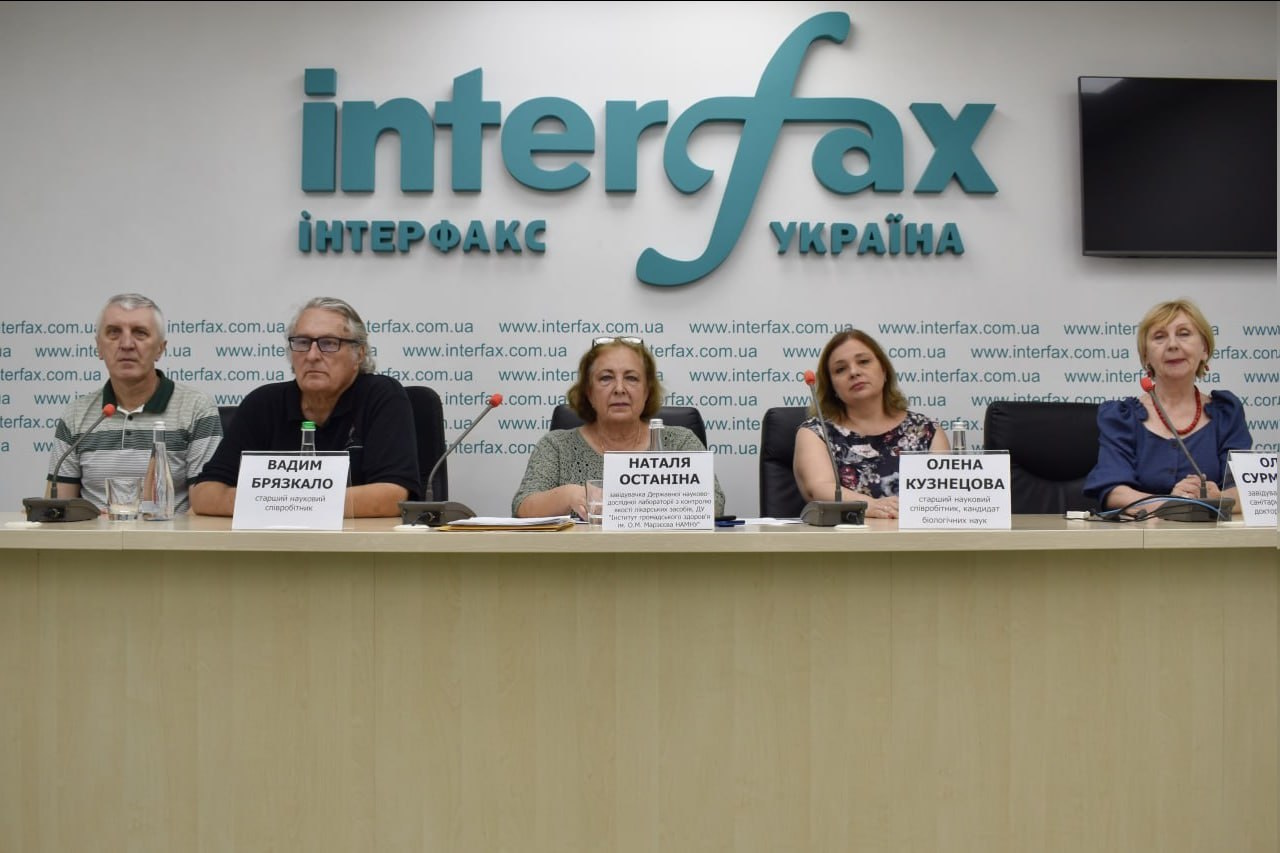
Kyiv. July 20. INTERFAX-UKRAINE – The leadership of Derzhliksluzhba (the State Medicines Service) is squeezing the laboratory of the Marzieiev Institute out of the market for quality control of medicines and drugs, believes laboratory head Natalia Ostanina.
“They are trying to accuse us of being incompetent, of falsifying data, of being unable to be an authorized laboratory on our Ukrainian market. We see that our laboratory is gradually being squeezed out of our market. We are not receiving any referrals, although for 28 years in a row we worked with Derzhliksluzhba, with the authorized bodies, with the Ministry of Health, the SBU, the police and other competent bodies,” she said at a press conference at the Interfax-Ukraine agency on Friday.
Ostanina noted that the laboratory has worked in the medicines quality control market for more than 27 years, is accredited under international ISO standards, including by the WHO, conducts scientific activity, is equipped with modern equipment, and also has a vivarium in its structure, which makes it possible to guarantee precise studies in accordance with international standards.
At the same time, Ostanina noted that the laboratory, which is part of the structure of a state institution of the National Academy of Medical Sciences of Ukraine (NAMS) and employs more than 40 people, receives funding for only 15 employees, with the rest funded through commercial contracts. Also, recently it has not received orders for such studies.
At the same time, according to Ostanina, in August last year a completely new laboratory appeared on the market and received its authority literally two weeks after it appeared.
“Since our laboratory stopped receiving quality control referrals from Derzhliksluzhba, we have been getting feedback. Everyone who was redirected to this new laboratory came back to us asking for help with carrying out the studies – the newly created laboratory had neither standards nor chemical reagents,” she said.
Ostanina also noted that because logistics in the country are disrupted, purchasing many reference substances is very difficult and slow today (more than 30–60 days for delivery).

“We handed over standards from our institute's archive and some chemicals with understanding, knowing that without this it is impossible to carry out quality control of medicines in our country, and our citizens would lose many drugs on our market,” the expert noted.
According to her, “all heads of departments connected with the quality control of medicines are apparently interested in the referrals not going to our laboratory.”
At the same time, Ostanina did not name the list of drugs in question. She only specified that it concerns LLC “Dobrobut Likilab”.
The laboratory head also reported that an investigation had been launched into the laboratory. There is a court ruling stating that the investigation had supposedly established that the laboratory of the state institution “Marzieiev Institute of Public Health of the NAMS of Ukraine” is abusing its official position and, together with authorized persons of a number of business entities, has implemented a scheme for the sale of substandard medicines in order to make a profit for itself, contrary to the interests of the state institution.
“We are accused of falsifying studies of medicines that the laboratory never carried out (…) As for the medicines that underwent control with us, absolutely all documents and the original logbooks of the analytical chemists, all primary data on how the analysis was carried out, copies of the job descriptions of the staff who work here and so on were seized. I think the law enforcement agencies will sort it out and prove who is right and who is to blame,” she said.
Ostanina reported that “the leadership of Derzhliksluzhba, having learned of the plans to hold a press conference, is intimidating us, saying they are ready to remove us from the list of authorized laboratories.”
“Derzhliksluzhba believes that by law only it has the right to decide where to send a medicine for quality control, without taking into account the capabilities of the authorized laboratories. I would not trust new private, newly created laboratories that have confirmed their competence in no way other than by receiving authority from Derzhliksluzhba. This is, after all, state quality control of medicines. We will appeal in an open letter to the president's administration, to the president of Ukraine, to the Cabinet of Ministers and to the Ministry of Health,” she said.
The laboratory head noted that the situation that has developed in the market for laboratory quality control services for medicines could lead to a number of drugs disappearing from the market.
“There are far fewer medicines on our market than there were a few years ago, or even two years ago. Of course, the war and difficult logistics are to blame, but so are the bans imposed by our Derzhliksluzhba. If the executors could not figure out how to carry out a study, they simply write that the drug does not meet the declared quality, and Derzhliksluzhba introduces a ban across the whole country,” she said.
Ostanina clarified, in particular, that medicines used in the season of acute respiratory viral infections to reduce fever and to improve well-being during autumn colds were initially banned. “In the autumn they were not available, and only in January, after arbitration control, did it suddenly turn out that everything in them was fine and correct, and they were released onto the market,” she noted.
According to her, a subjective approach to organizing the quality control of medicines and the involvement of insufficiently qualified specialists in carrying out the control may lead to a drug actually being withdrawn from our market.
The state scientific research laboratory for the quality control of medicines of the state institution “Marzieiev Institute of Public Health of the NAMS of Ukraine” was established in 1996; it employs four doctors of sciences, 10 candidates of sciences and 30 research fellows.
Accredited by the National Accreditation Agency of Ukraine in accordance with the requirements of GOST EN ISO/IEC 17025:2019 (EN ISO/IEC 17025:2017, IDT; ISO/IEC 17025:2017 IDT), certified by Derzhliksluzhba,
The quality management system is certified by the Ukrainian Medical Certification Center for compliance with the requirements of DSTU EN ISO 9001:2018.
The laboratory is the only one among scientific state institutions to have been requalified by the WHO for the right to carry out quality control of medicines.