New educational platforms should become the basis for modernizing Ukraine's agricultural sector – experts
International support, the development of vocational education and the rapid introduction of practice-oriented training solutions are critically important for preserving the competitiveness of Ukraine's agricultural sector, which in wartime remains a key source of foreign-currency earnings and one of the drivers of the economy, participants of the press conference “International Partnership for the Development of Training in Ukraine's Agricultural Sector” said. During the discussion, the speakers stressed that the agricultural industry is increasingly
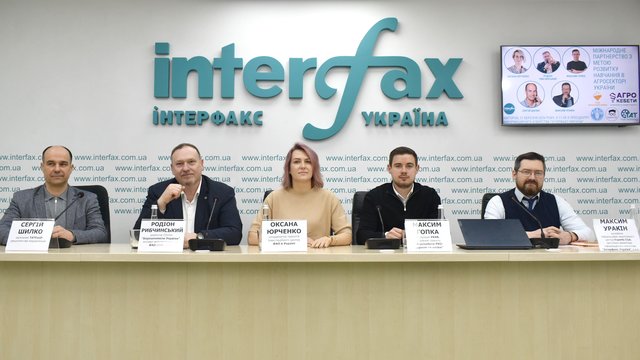
International support, the development of vocational education and the rapid introduction of practice-oriented training solutions are critically important for preserving the competitiveness of Ukraine's agricultural sector, which in wartime remains a key source of foreign-currency earnings and one of the drivers of the economy, participants of the press conference “International Partnership for the Development of Training in Ukraine's Agricultural Sector” said.
During the discussion, the speakers stressed that the agricultural industry is increasingly facing a shortage of personnel, a need to retrain staff, adaptation to new EU standards and demand for modern digital knowledge – from post-harvest grain processing to artificial intelligence technologies in agricultural production.
Maksym Urakin, founder of the Experts Club information and analytical center and deputy director of the Interfax-Ukraine agency, stressed that under current conditions the development of education in the agricultural sector is directly linked to the state's economic resilience.
“Today, Ukraine's economy depends to a significant extent on the assistance of international partners, and this must be said plainly. However, Ukraine cannot build its future on external support alone, so we need industries that generate foreign-currency earnings, sustain employment and form the tax base, and the agricultural sector remains exactly such a sector,” – he stressed at a press conference at the Interfax-Ukraine agency on Tuesday.

According to Urakin, one example of such practical partnership was the launch of the online course “Application of Artificial Intelligence Technologies in Agricultural Production,” implemented by Experts Club together with AgriAcademy on the initiative of the EBRD within food security support programs. He stressed that for Ukrainian farmers the solutions that matter most are those that allow them not just to talk about innovation but to turn it into concrete business tools.
“The purpose of this course – is to move the conversation about artificial intelligence from the level of abstractions to the level of concrete business solutions. Today, Ukraine needs a new system of training for farmers – one that is more technological, more systematic and combines international practice, business expertise and applied tasks,” – Urakin noted.
For her part, Oksana Yurchenko, project coordinator of the FAO Investment Centre in Ukraine, noted that the shortage of personnel in the agricultural sector is a chronic problem that has not disappeared either after the pandemic or in conditions of full-scale war, and therefore it is accessible distance-learning formats that are becoming one of the few realistic ways to quickly strengthen workers' qualifications.
“The problem of qualified personnel for the agricultural sector has been, is and will remain one of the key ones. Farm workers often find it difficult to attend offline training because of their schedules and distance, so the industry needs accessible, practical and flexible training that can be taken without leaving work,” – she noted.

Yurchenko recalled that the AgriAcademy platform was created in response to the demand of large agribusiness and international partners for systematic training for the industry in wartime. According to her, the platform already hosts more than 40 courses, developed with the participation of business and Ukrainian and international experts and adapted to the sector's current needs. Special emphasis is placed not only on crop production but also on livestock farming, where requirements for biosecurity, animal health, welfare and compliance with European standards have risen sharply.
“If we look at the number of diplomas and certificates issued by the AgriAcademy platform, we are already talking about more than 3.5 thousand documents. At the same time, the number of registered learners who are still studying or plan to complete their training is roughly three times larger, which points to steady growth of interest in the platform,” – Yurchenko reported.
She also drew attention to the fact that since January 1, 2026, mandatory animal welfare requirements have already applied to all agricultural enterprises that keep animals, so demand for specialized training will only grow. According to the expert, the courses on the platform are not yet legally mandatory, but they are in practice becoming an important practical tool for correctly interpreting and implementing the new norms at enterprises.
Rodion Rybchynskyi, director of the Union “Flour Millers of Ukraine” and a grain sector expert of the UN FAO, noted that the personnel problem concerns not only agricultural production but the entire agri-food sector, including processing and the food industry, where the automation of many processes cannot yet replace people.
“The personnel problem for the food industry is even more acute today than for agricultural production itself. In the field you can already use driverless combines or tractors, but nobody has figured out how to make bread, groats, pasta or other food products without people, so the quality of personnel and the quality of knowledge is the challenge number one here,” – he added.

Rybchynskyi stressed that in the context of European integration, food industry enterprises must not only look for workers but also quickly raise their qualifications in line with new regulations, technological requirements and quality standards. That is why, in his words, educational platforms such as AgriAcademy should develop in parallel with formal education.
The expert also said that a course on post-harvest handling and storage of grain is already available on the platform, and a course on processing groat crops is due to appear soon. At the same time, as the expert stressed, the main task of such programs – is to give specialists a high-quality foundation without which it is impossible to move toward innovation.
Maksym Hopka, head of the project “Agrokebety PRO: Grains and Oilseeds” of the UCAB association, said that retraining, short applied programs and training with a practical component are today among the most effective tools for responding to the personnel crisis in the agricultural sector.

“Today the agricultural sphere in Ukraine faces a serious shortage of personnel, so fast, practice-oriented educational solutions are becoming key. Our approach – is not just training but the formation of a new quality of human capital for the agricultural sector by combining theory, practice and direct interaction with business,” – he noted.
According to Hopka, within one of the programs almost 984 people registered for training, and 552 have already completed it. Some of the participants also went through the practical component, after which some of the graduates found employment or continued working in a related area of the industry. Special attention in such programs, he said, was paid to internally displaced persons, young people, people with disabilities and war veterans.
Hopka separately stressed that it is important not only to create new educational products but also to ensure their close link with higher education. He said that within educational projects more than seven memoranda have already been signed with leading agrarian universities, and some programs are being implemented as a supplement to master's courses with the involvement of business representatives and foreign educational partners.
Serhii Shylko, founder of TATFooD and a recruiting media agency, commenting on the situation in the labor market, noted that for employers under current conditions the main challenge is no longer just finding a specialist but the ability to retain a person by offering stability, clear working conditions and the possibility of professional development.
“Today the success of an agrifood business is determined not by the search for the ideal specialist but by the ability to fit into a person's life ‘anchor,’ to give them stability and prospects. A technologist at a production site must now be both a mentor for line staff and a process manager, so training platforms should help adapt specialists to the new working conditions,” – he said.

Shylko also stressed the importance of the concept of lifelong learning and noted that the market already needs programs that workers can take alongside their jobs, without a long break in the production cycle. In his opinion, state and private initiatives in this area should not duplicate one another but cover different segments of need – from blue-collar occupations to modern digital competencies, which are currently lacking even in formal retraining mechanisms.
During the discussion, the speakers also separately addressed the state of academic education. They noted that the classical system of training personnel in many cases can no longer keep up with the pace of change in the industry, in particular because of a weak material base, low pay for teachers and a lack of sufficient resources for laboratories and modern equipment. At the same time, as the participants noted, it is precisely an alliance of business, universities and professional associations that can become the model that will deliver a tangible effect.
Rodion Rybchynskyi gave examples of involving instructors from specialized Ukrainian universities in developing and teaching courses, as well as of cooperation between business and universities in creating modern laboratories, in particular on the basis of specialized higher education institutions. The participants of the press conference agreed that without such a partnership a full-fledged renewal of personnel for the agricultural sector will be impossible.
A separate block was the question of a possible influx of foreign workers into Ukraine against the backdrop of the personnel shortage. Representatives of the processing sector noted that there is already some demand for such workers, but in practice it often runs up against migration legislation and organizational difficulties. At the same time, in the assessment of Oksana Yurchenko, if such a scenario is partly possible for processing and certain production areas, it is unlikely to become widespread in the livestock segment.
Overall, the participants of the press conference concluded that in conditions of war, demographic pressure and tougher competition in foreign markets the agricultural sector can no longer rely solely on traditional approaches to training personnel. In their view, it is precisely international partnership, digital educational platforms, short practical programs, business participation in training and the modernization of academic education that should become the basis of a new personnel model for Ukrainian agribusiness.