OPINION: Why and how Alyona Shevtsova ended up among the speakers at a compliance conference in London
Alyona Shevtsova, who is under sanctions in Ukraine, spoke at the PAY360 forum in London. Liubov Velychko explains why Alyona Shevtsova's participation in such a conference became possible. The way Shevtsova presented herself at PAY360 in London in March 2026. In Ukraine, meanwhile, investigators link her to money laundering through Aibox Bank and “miscoding” schemes worth more than $110 million. The scandal

Alyona Shevtsova, who is under sanctions in Ukraine, spoke at the PAY360 forum in London. Liubov Velychko explains why Alyona Shevtsova's participation in such a conference became possible. The way Shevtsova presented herself at PAY360 in London in March 2026. In Ukraine, meanwhile, investigators link her to money laundering through Aibox Bank and “miscoding” schemes worth more than $110 million. The Shevtsova scandal has brought renewed attention to the question of how effective British due diligence procedures are.
Ukrainian fintech executive Alyona Shevtsova, who is under sanctions in her own country and, according to investigators, is linked to a financial scheme worth more than $110 million, was able to appear as a speaker and, through her company, sponsor a major compliance event in the UK. The situation exposed the gulf between formal regulatory standards and their real-world application.
What exactly do Ukrainian law enforcement officials accuse Alyona Shevtsova of?
In Ukraine, Alyona Shevtsova's name is associated with the revocation of a banking licence, ongoing criminal investigations and sanctions imposed by the National Security and Defense Council. In London, she presents herself as a fintech executive, an award winner and a speaker at a key compliance event where tickets cost more than £1,000.
On March 25–26, Alyona Shevtsova took part in the PAY360 conference at ExCeL London — one of the key industry events, held with the support of the UK Department for Business and Trade and bringing together entrepreneurs and law enforcement specialists in the field of financial crime. Her company Sends was among four platinum sponsors and had a separate stand in the exhibition area. Shevtsova herself also spoke on two panels.
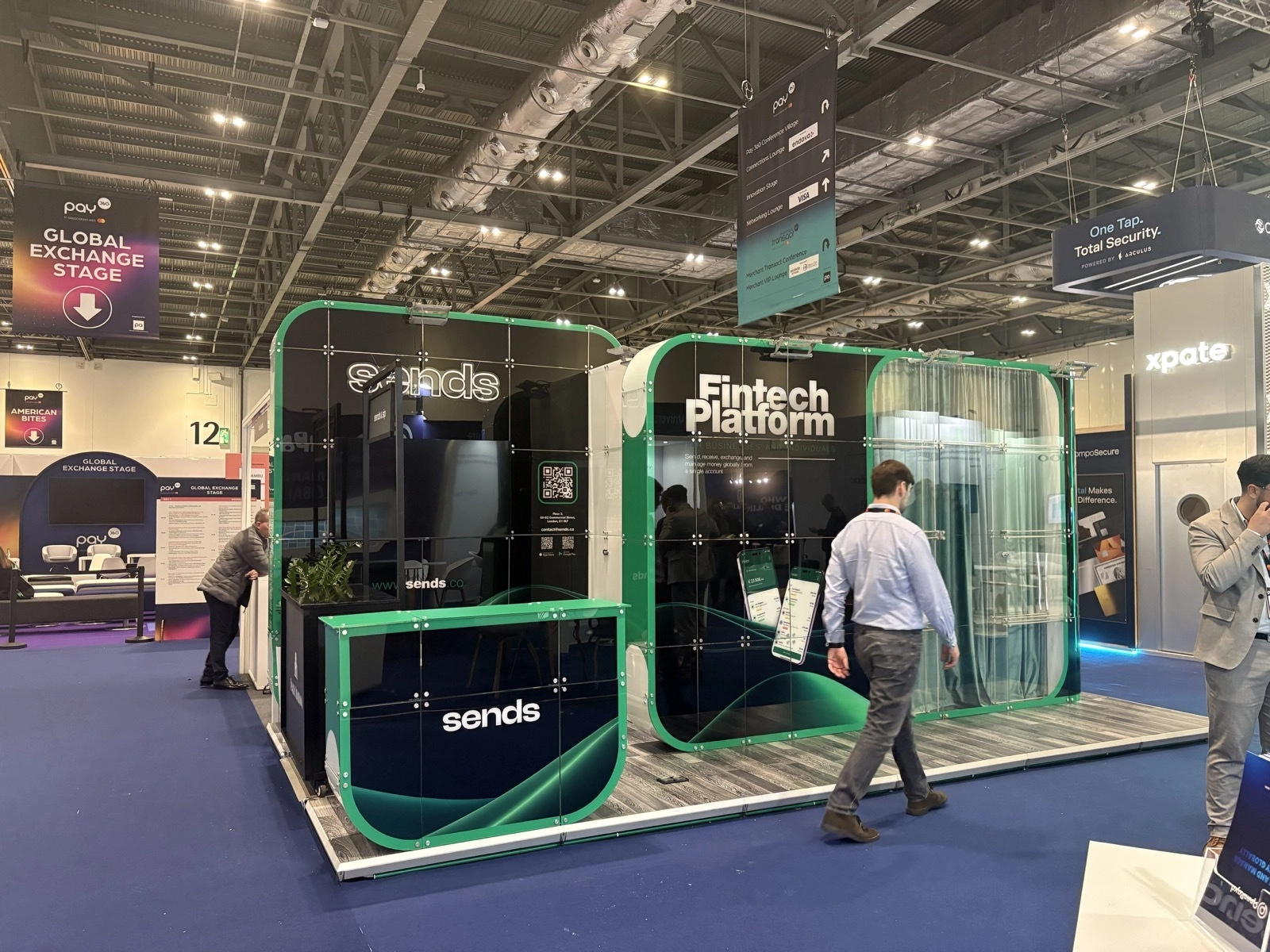
The Sends company stand in the exhibition area of the PAY360 conference — the largest event dedicated to the payments industry. Photo: Kyiv Post
“She spent a significant amount of money on this event,” several participants told Kyiv Post.
On the official PAY360 website, Shevtsova is presented as a fintech entrepreneur and panel speaker, including on “The agentic AI tsunami: revolutionising compliance via AML and KYC”. Her biography emphasizes her role in ensuring the resilience of Ukraine's payment system during the war, and also mentions partnerships with global companies, including Mastercard and Visa, and awards from international organizations and the Ukrainian government.
Her prominent presence at an event devoted to compliance contrasts with how Ukrainian authorities describe her. According to the Bureau of Economic Security of Ukraine, the money laundering case concerns the alleged misappropriation of more than $110 million. Investigators believe the scheme made it possible to launder funds obtained from the illegal activity of online casinos.
The Aibox Bank also features in the money laundering case — a Ukrainian bank in which Alyona Shevtsova held a significant stake. Its licence was revoked by the National Bank of Ukraine in March 2023 over systemic violations of anti-money-laundering legislation. The decision was part of the state's broader fight against so-called “miscoding” schemes, in which payment transactions were deliberately assigned incorrect merchant category codes (MCC) — for example, gambling payments were disguised as payments for utilities or retail purchases — in order to conceal their true nature and avoid taxation.
On April 12, 2025, Ukraine's president Volodymyr Zelensky enacted a decision of the National Security and Defense Council imposing sanctions on four individuals, among them Alyona Shevtsova.
What role did Shevtsova play at the PAY360 conference in London?
But neither the investigations, nor the sanctions, nor the closure of the bank were mentioned during the PAY360 conference.
At the same time, Shevtsova continues to work in the UK through her fintech business. Her company Sends is registered here. Its trading name is Smartflow Payments Limited — a company registered in England and Wales (No. 11070048) and authorised by the UK Financial Conduct Authority (FCA) under registration number 900873.
Over two days, thousands of participants passed through the halls of the PAY360 conference: by various estimates, between 5,000 and 10,000 people. Among the key themes of the event were artificial intelligence and compliance. Financial crime, as expected for an event of this scale, also remained in the spotlight.
Shevtsova was conspicuously active: she smiled, greeted visitors and held business conversations, with no visible sign that her controversial past was being discussed or even mentioned.
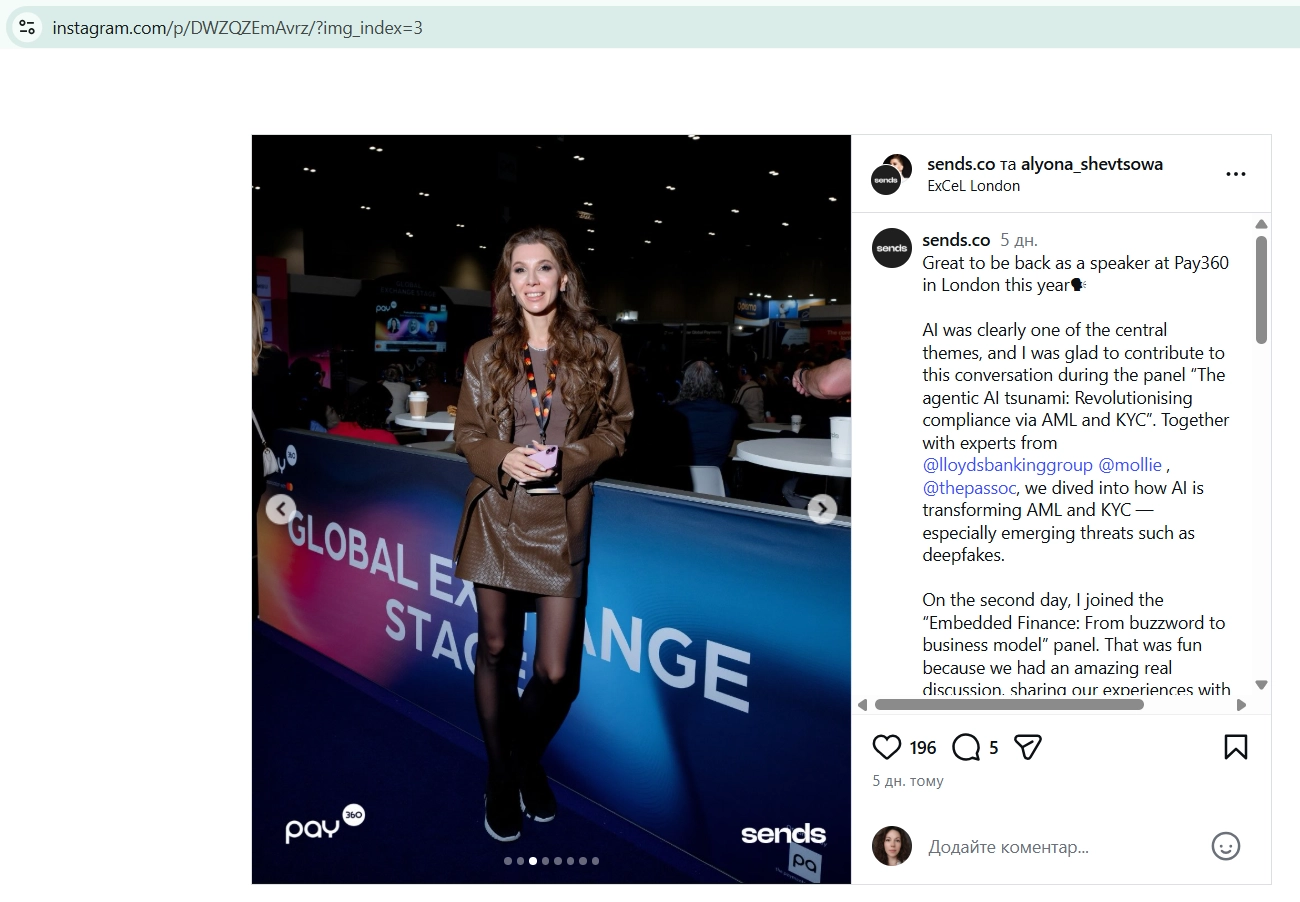
Screenshot of a post on the page of the company Sends and Alyona Shevtsova after the PAY360 conference
At PAY360, many participants did not know about Shevtsova's background, but reacted instantly as soon as they heard about it.
“No. There is no chance this would have passed the check,” was the answer of about half of those surveyed by Kyiv Post when assessing whether such a profile could pass enhanced due diligence in the UK. Others were more cautious: “Maybe. It depends on the jurisdiction, on whether the country is considered an ally and on what exactly is involved in the case.” But when it was clarified that the person in question was Shevtsova — a speaker and sponsor of the event — reactions changed sharply: “That is a scandal.”
During the panels, her background was not mentioned, nor was Aibox Bank.
One telling moment: not all reactions were critical. One participant replied: “Wow. Now I'm even more interested in working with her. I would gladly cooperate.” And he added: “She knows everything about money. If she managed to do all this, leave the country and speak at this event… bravo. She knows her business. She is a dark genius.”
In a post, published after the event, the company Sends described Shevtsova's participation as part of broader industry discussions on artificial intelligence and financial compliance. According to the company, she joined panels devoted to AI-based AML and KYC solutions as well as embedded finance, stressing the importance of combining technological innovation with strong governance and clear business logic.
This case shows the gap between what the global financial industry declares about compliance and how it works in practice. People whose integrity raises many questions can still operate in this system — and even gain legitimacy within it. In that sense, compliance risks turning not into a filter but into a platform.
The views of the article's author do not necessarily reflect those of Kyiv Post.